Whispers in Moonlight: The Domestic Cat, a Silent Guardian Bridging Ancient Deserts and Modern Harths
Evolved from the African wildcat, this enigmatic predator navigates urban landscapes with stealth and grace, its survival a testament to adaptation yet threatened by human encroachment and loss of wild essence.
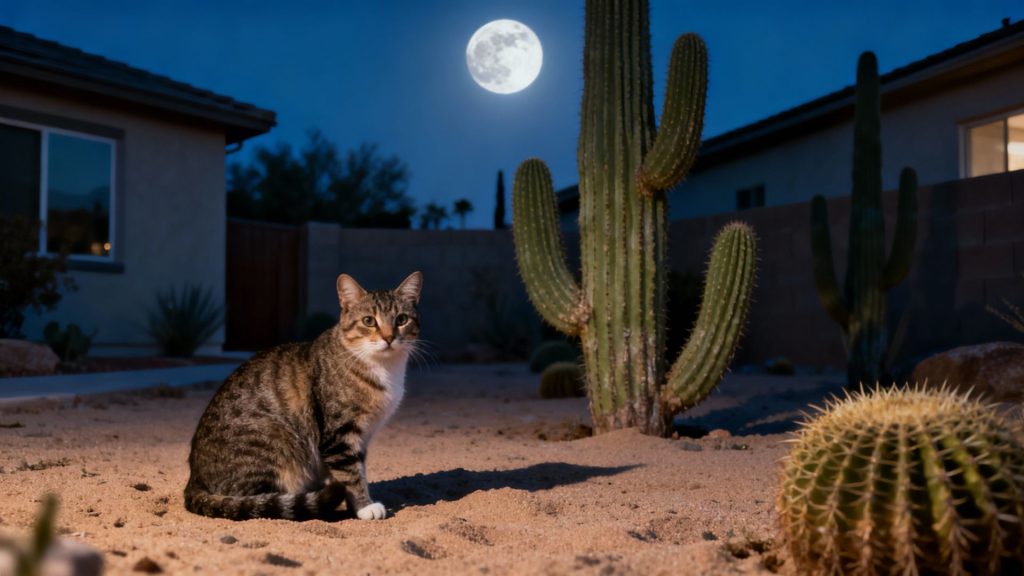
In the hushed stillness of a moonlit alley, a shadow glides with liquid grace—a domestic cat, Felis catus, its emerald eyes piercing the darkness like twin beacons. This creature, no larger than a loaf of bread, moves with a predator’s precision, each step a silent testament to millennia of evolution. Here, amidst concrete and ivy, it embodies the wild spirit of its ancestors, a ghostly presence that transforms the mundane into a theater of survival. The rustle of a leaf, the distant hum of the city—all fade into the background as the cat pauses, ears twitching, a living sculpture of alertness in an urban wilderness.
Natural selection forged this feline into a master of nocturnal realms, gifting it with eyes that capture 50% more light than humans, pupils dilating like apertures to unveil the night. Its ears, capable of detecting ultrasonic frequencies up to 64 kHz, swivel independently, triangulating the faintest scurry of prey—a legacy from the arid African savannas where survival hinged on such sensory acuity. This evolutionary blade cuts deep: the cat’s retractable claws, silent and deadly, evolved not for combat but for ambush, allowing it to scale vertical surfaces with spider-like agility. Such adaptations, honed over 10,000 years since domestication, reveal a creature exquisitely tuned to exploit niches, from desert dunes to suburban gardens, where it remains an apex micro-predator.
Daily existence unfolds as a delicate dance of instinct and opportunity. The cat’s hunting strategy—a blend of stalking, pouncing, and killing—is encoded in its DNA, a ritual performed with mechanical efficiency. It consumes small mammals, birds, and insects, its diet reflecting opportunistic versatility; in urban settings, this reduces rodent populations, a service rendered unwittingly. Yet, this survival poem carries a paradox: the same skills that ensure sustenance in the wild lead to overhunting in fragmented habitats, where introduced species fall prey. The cat’s crepuscular rhythms—active at dawn and dusk—mirror the pulse of its environment, a solitary forager that may spend hours in patient vigil, embodying both vulnerability and resilience in every calculated move.
Reproductive bonds weave a tapestry of continuity, yet remain fleeting and functional. Females enter estrus multiple times a year, signaling readiness with scent and sound; males compete fiercely, their battles brief but intense. After a gestation of 65 days, a litter of 3-5 kittens emerges blind and helpless, wholly dependent on the mother’s milk and protection for weeks. She grooms them meticulously, teaching hunting through play—a transfer of knowledge that ensures species persistence. While often perceived as solitary, cats display complex social structures in colonies, sharing territories and resources through subtle vocalizations and body language, a testament to the evolutionary advantage of communal support in high-density areas. This nurturing phase highlights life’s fragile beauty, where each generation carries forward the genetic wisdom of survival.
As an ecological linchpin, the domestic cat shapes microcosms it inhabits. In rural and urban ecosystems, it acts as a natural regulator, curbing rodent outbreaks that could spread disease or damage crops. Studies indicate that free-ranging cats can influence local biodiversity, sometimes reducing small vertebrate populations by up to 30%, a role that underscores their unintended impact as both protector and disruptor. Yet, this keystone function is double-edged: in island habitats, introduced cats have driven endemic species to extinction, revealing the delicate balance between their adaptive prowess and ecological responsibility. Their presence serves as a barometer of human-altered landscapes, where they thrive yet contribute to broader environmental narratives.
Today, this ancient companion faces modern perils: habitat fragmentation from urbanization, road accidents, and diseases like feline leukemia. Over 200 million cats live globally, but stray populations suffer high mortality, with only 25% surviving their first year outdoors. Conservation efforts, such as trap-neuter-return programs, aim to stabilize numbers without eradicating their wild essence. The challenge lies not in despair but in coexistence—recognizing that the cat’s resilience, forged in deserts, can adapt to our shared future if we mitigate threats through education and humane management. This twilight era demands a shift from indifference to stewardship, honoring the bond that began when humans first welcomed these hunters into their homes.
In the cat’s silent gaze, we glimpse the eternal dialogue between nature and civilization. Its journey—from wild hunter to hearth guardian—mirrors humanity’s own evolution, a reminder of adaptability’s power and the cost of disconnection. This small carnivore teaches that survival is not conquest but harmony, urging us to preserve the wild within the tame. As shadows lengthen and cities sleep, the cat endures, a living emblem of life’s tenacity, inviting reflection on our role in a shared, fragile world.