Whispers in the Twilight: The Domestic Cat, An Ancient Predator Woven into the Fabric of Human Hearth
From the deserts of North Africa to our urban sanctuaries, the cat embodies nature’s unyielding independence, evolving as a master hunter that shapes ecosystems while dwelling in the silent spaces of our lives.
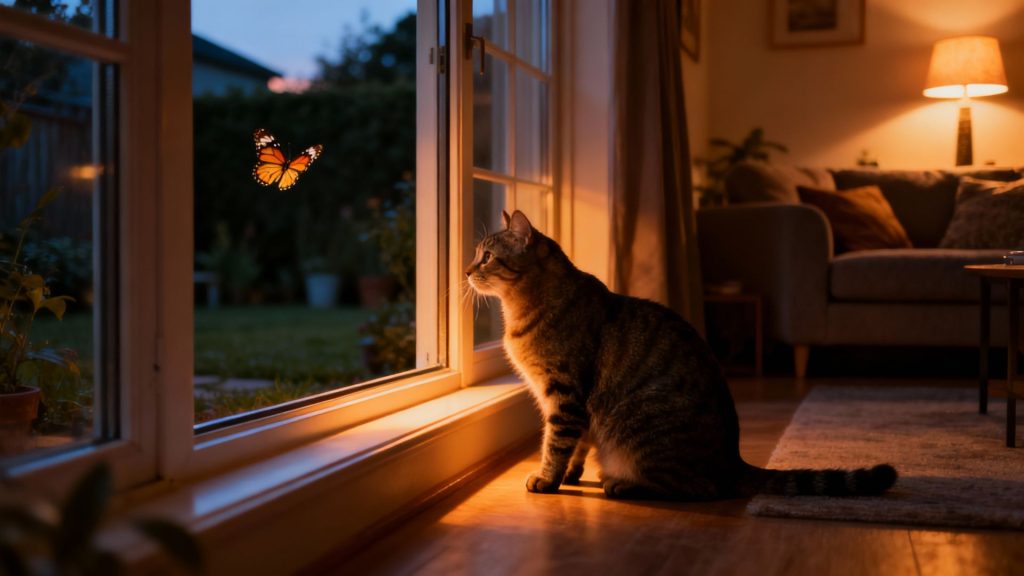
In the fading light of dusk, a silhouette emerges—fluid and silent—against the backdrop of a wild meadow. Eyes like twin embers pierce the gloaming, reflecting an ancient lineage. This is the domestic cat, Felis catus, a creature that moves with the grace of a shadow, its presence evoking a primal reverence. In this moment, it is not merely a pet but a living relic of untamed wilderness, bridging the divide between human habitation and the untamed world. The air hums with the scent of earth and possibility, as the cat’s alert posture signals a timeless vigilance, unchanged since its ancestors roamed the deserts millennia ago.
The evolutionary blade that forged this feline marvel lies in its unparalleled adaptations for predation, sculpted over millennia. Retractable claws, a feature inherited from wild progenitors like the African wildcat (Felis silvestris lybica), allow for silent stalking and lethal precision. Keen senses define its existence: vision tuned to low light captures the faintest movements, while whiskers detect minute air currents, turning each hunt into a symphony of sensory input. These traits were honed through natural selection in arid landscapes, where survival demanded efficiency in capturing small prey. The cat’s lean musculature and flexible spine, products of this evolutionary crucible, enable bursts of speed and acrobatic prowess, transforming it into a consummate solitary hunter in any environment.
Daily survival unfolds as a delicate dance of instinct and adaptation, where the cat’s behaviors echo ancient rhythms. As a crepuscular predator, it thrives in the twilight hours, using stealth to ambush rodents and insects—a role that inadvertently made it humanity’s ally in grain stores across early civilizations. Play serves as vital practice; pouncing on leaves or toys refines coordination, a survival strategy encoded in its DNA. Solitude defines much of its existence, yet opportunistic gatherings around food sources reveal a flexible sociality, where brief interactions sustain life without eroding independence. This balance between solitary pursuit and communal survival speaks to an enduring resilience, a testament to how environmental pressures shaped a creature perfectly attuned to exploit the niches of human-altered landscapes.
Reproductive rites and familial bonds, though minimal compared to pack animals, unfold with understated elegance. Female cats, or queens, may form loose colonies while raising kittens, fostering survival through shared vigilance and communal nursing. Maternal care is intense but fleeting; after two months, offspring disperse to carve their own territories, embodying a life cycle built on self-reliance. This brief period of connection underscores an evolutionary strategy: invest in rapid independence to maximize genetic proliferation. Such dynamics highlight how cats navigate the tension between ephemeral kinship and enduring solitude, ensuring their lineage persists through millennia of environmental flux.
Ecologically, the domestic cat occupies a dual role—as a keystone predator controlling pests in human settlements and as an invasive species with profound impacts on native wildlife. Introduced globally, it suppresses rodent populations that threaten crops, yet in ecosystems like island habitats, it decimates birds and small mammals, altering biodiversity. Conservation efforts focus on managing this paradox through responsible ownership, reflecting a broader human responsibility to harmonize coexistence with nature’s intricate web.
In the quiet solitude of a cat’s gaze, we confront nature’s essence—a blend of fragility and indomitable spirit, urging humanity toward humility and deeper ecological stewardship.