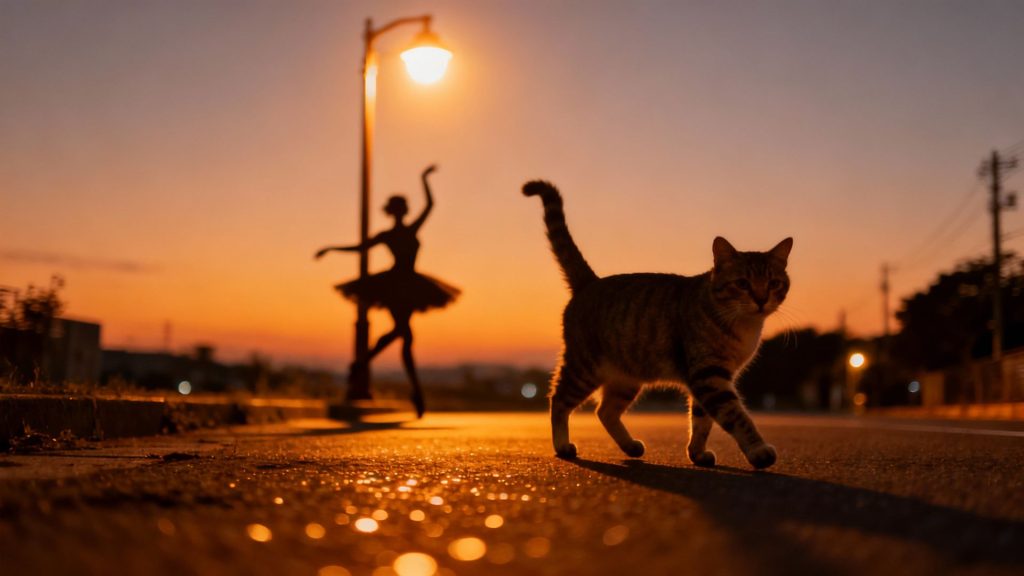
Whispers of Twilight: The Domestic Cat, a Shadow Dancer in the Realm of Humans
Descended from solitary hunters of ancient deserts, cats now navigate human domains with stealth and grace, their primal instincts subtly bridging wild independence and domestic harmony.
As dusk descends upon a cityscape, the first shadows lengthen, and a lithe form emerges from beneath a parked car—a domestic cat, Felis catus. Its fur, a tapestry of muted grays and browns, ripples with each silent step, eyes luminous orbs capturing the last glimmers of daylight. This moment, suspended between twilight and darkness, evokes primordial echoes: a predator born of arid wilds now prowling urban edges, an embodiment of nature’s enduring pulse amidst human sprawl. The air hums with the scent of damp earth and distant traffic, the cat’s presence a quiet testament to adaptability, a living sculpture of evolutionary artistry in the concrete jungle.
Millennia of natural selection forged this feline into an apex micro-predator. Its retractable claws, honed for silent stalking, allow precise strikes on prey, while night vision enhanced by a tapetum lucidum—a reflective layer behind the retina—paints darkness in shades of green and gold, granting unmatched nocturnal prowess. Acute hearing detects the faint rustle of a mouse at 30 meters, a survival edge inherited from desert ancestors who navigated sparse landscapes. This sensory toolkit, a scalpel of evolution, carved the cat’s niche: a solitary hunter thriving on stealth, where every whisker-touch maps the world in vibrations, turning the mundane into a theater of survival.
Daily existence unfolds as a delicate ballet of predation and rest. Cats stalk invisible trails through gardens and alleys, pouncing with coiled energy on unsuspecting insects or rodents—a behavior unchanged from wild forebears. Their diet, obligate carnivores, demands high-protein meals, driving efficient hunting sequences: crouch, stalk, leap. Yet in domesticity, this ancient ritual manifests in playful swats at toys, a neural relic of feral days. Napping for up to 16 hours conserves energy, punctuated by bursts of activity that mirror natural cycles, a rhythm etched deep in their DNA, transforming living rooms into micro-habitats where survival poetry is written in quiet leaps and curled slumber.
Reproductive sagas reveal a nuanced social tapestry. Females enter estrus seasonally, signaling readiness through scent and vocalizations to attract mates. After a 65-day gestation, litters of 2-6 kittens emerge blind and helpless, their survival hinging on maternal devotion: the mother grooms, nurses, and teaches hunting skills in dens hidden from prying eyes. This phase, though brief, fosters lifelong bonds among siblings, yet cats retain ancestral solitude, forming loose colonies only where resources abound. Such kinship, a balance of nurture and independence, echoes the evolutionary tightrope walked between cooperation for lineage continuity and the fierce self-reliance that defines feline heritage.
In ecosystems reshaped by humans, cats serve as inadvertent engineers, controlling rodent populations that might otherwise flourish, reducing agricultural pests and disease vectors. Yet their impact is dual-edged: as invasive predators in sensitive habitats, they threaten native bird species, while in homes, they offer emotional solace, lowering human stress through purring vibrations—a biological lullaby. This ecological duality underscores their role as both guardians and disruptors, a testament to how life adapts, weaving new webs in anthropogenic realms, where each hunting success whispers of nature’s intricate checks and balances.
Modern threats loom large. Overpopulation from uncontrolled breeding inundates shelters, where euthanasia claims millions annually. Diseases like feline leukemia and habitat loss through urbanization push stray populations to peril. Yet conservation measures, including spay-neuter programs championed by organizations like Alley Cat Allies, offer hope, curbing numbers and promoting adoption. Scientific studies reveal stable global populations, but localized declines persist, a reminder that resilience is tested not by extinction’s shadow, but by humanity’s capacity for stewardship—a quiet revolution in coexistence.
In the domestic cat, we glimpse nature’s timeless dialogue: a creature sculpted by deserts now purring on our laps, embodying the paradox of wild hearts in tamed spaces. Its independence mirrors our own quest for autonomy, while its vulnerability calls for compassion. As shadows lengthen at day’s end, this small hunter reminds us that evolution is not a relic, but a living current—a dance of adaptation that binds all life in fragile, enduring harmony.