Whispers from the Ancient Hearth: The Canine Soul’s Journey from Wild Roots to Human Heart
Unraveling the evolutionary tapestry that forged dogs into humanity’s eternal companions, bridging instinct with devotion in a dance of mutual survival and shared destiny.
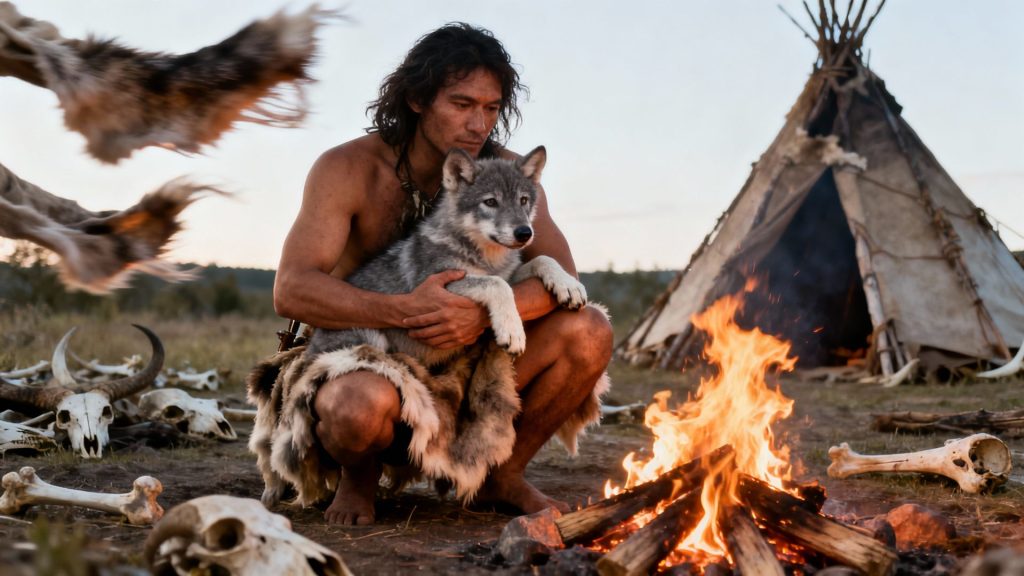
Picture a mist-shrouded dawn in the Eurasian steppes, where the first tentative bonds between wolf and human ignited—a flicker of curiosity in amber eyes meeting the guarded warmth of a campfire, etching the dawn of a partnership that would span millennia. In this primal moment, the ancestors of modern dogs emerged not as predators, but as silent observers, drawn by the promise of shared warmth and scavenged scraps, their presence a bridge between untamed wilderness and burgeoning human settlements.
Evolution sculpted this transformation with precision: genes favoring docility and social intelligence, such as variations in the WBSCR17 region linked to hypersocial behavior, allowed wolves to thrive near humans without fear. Over 15,000 years, natural selection honed adaptations like heightened olfactory senses—capable of detecting scents at parts per trillion—and altered cortisol responses that fostered calmness in chaos, turning solitary hunters into cooperative allies attuned to human cues. This biological alchemy, documented through fossil records and genomic studies, reveals how dogs became masters of emotional attunement, their survival hinging on an unspoken pact forged in firelight.
Daily existence for dogs unfolds as a symphony of instinct refined by domestication: foraging skills adapted to urban landscapes, where they navigate complex environments using scent trails and spatial memory; playful chases that mimic ancestral hunts, strengthening social bonds; and nest-building behaviors in dens or domestic corners, a testament to their ingrained need for security. These routines, observed in feral populations and household pets alike, showcase a resilience that balances wild heritage with learned adaptability, their lives a quiet testament to the art of thriving in flux.
Reproductive rhythms echo the deep connections within canine society: breeding seasons timed to optimize survival, with females nurturing litters through communal care—pups learning hierarchy through gentle nips and tail wags. This familial tapestry, enriched by pheromone-driven communication, weaves a narrative of continuity, where generations pass on traits like loyalty and protective instincts, cementing dogs as architects of enduring kinship in a transient world.
As ecological linchpins, dogs reshape habitats through roles like seed dispersers in parks or apex influencers in urban food webs, their presence curbing rodent populations and fostering biodiversity. Scientific surveys highlight their status as keystone companions, with studies showing how their interactions promote ecosystem health in human-altered landscapes, making them indispensable threads in the fabric of co-evolved life.
Yet shadows loom: habitat fragmentation, disease outbreaks like canine distemper, and abandonment crises threaten populations, with global estimates indicating millions of stray dogs facing malnutrition. Conservation efforts, led by organizations such as the World Small Animal Veterinary Association, offer hope through vaccination drives and adoption programs, underscoring a path toward coexistence rooted in compassion rather than neglect.
In the silent gaze of a dog rests an eternal dialogue about trust and interdependence—a mirror to humanity’s own journey. Their story, a testament to life’s tenacity, invites reflection on our role as stewards, urging us to honor the wild heart that beats within every loyal companion and to cherish the bonds that unite us in the grand tapestry of existence.