Ghost of the Frozen Peaks: The Snow Leopard, Weaving Solitude into the Tapestry of Thin Air
Mastering the art of survival in Earth’s highest realms, this elusive predator faces mounting threats from climate shifts and human encroachment, embodying nature’s fragile resilience.
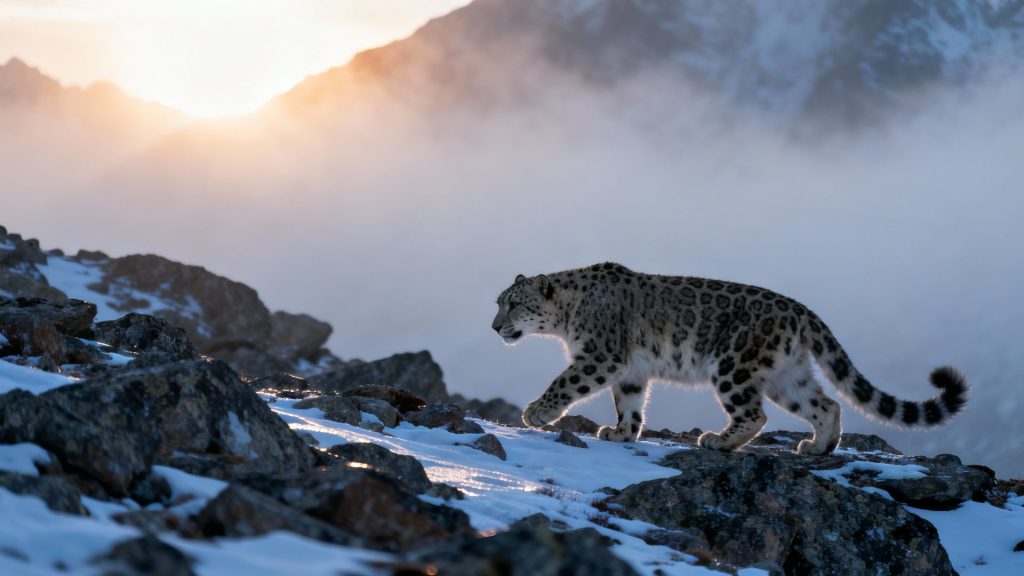
Imagine standing atop a windswept ridge in the Himalayas, where jagged rock meets icy sky; a sudden movement in the snow-dusted cliffs reveals the ghostly form of a snow leopard, its pale coat merging seamlessly with the alpine canvas. This first encounter etches awe into the soul, the animal’s silent grace a testament to the wild’s untamed beauty. Thick fur glistens under a weak sun, eyes like liquid amber scanning horizons for unseen dangers. In this harsh, oxygen-thin world, every breath is a battle against the elements, yet the snow leopard moves with effortless poise, embodying the mountain spirit.
Evolution forged this felid with tools to conquer altitude: a dense pelt insulates against sub-zero cold, while enlarged nasal cavities oxygenate blood efficiently for heights over 5,000 meters. Its long, muscular tail acts as a counterbalance on treacherous slopes, and broad, padded paws distribute weight like snowshoes, preventing sinking. This anatomical blueprint, sculpted by millennia of natural selection, reflects a dance of adaptation—where each trait answers the relentless call of the mountains. Without such refinements, life in this vertical desert would be impossible, a reminder of nature’s incremental genius.
Daily existence unfolds as a poem of precision: the snow leopard hunts blue sheep and ibex with stealth perfected by patience, stalking for hours before a pounce as swift as ice melt. In winter, it tracks prey through snowdrifts, relying on keen eyesight to spot movements from afar; its diet shifts seasonally, ensuring sustenance in scarcity. Solitary for most of its life, this predator navigates vast home ranges, marking territory with scent to avoid conflict—a strategy born of isolation. Each hunt is a high-stakes ballet, where failure could mean starvation, emphasizing survival’s delicate choreography.
Reproduction offers rare connection: females raise cubs alone, teaching skills in cliffside dens for two years. Cubs mimic adult hunts through play, building strength for independence—a bond forged in silence, critical for species continuity. Despite solitary tendencies, this nurturing phase sustains populations, with densities low due to harsh environments. Life expectancy stretches to 15 years in the wild, a testament to maternal sacrifice and the slow pulse of mountain time.
As an apex predator, the snow leopard anchors alpine ecosystems, regulating herbivore herds to prevent overgrazing and maintain biodiversity. Its presence signals ecosystem health; declines warn of imbalance, as seen in studies where reduced numbers lead to degraded pastures. This keystone role extends beyond ecology, embodying nature’s checks and balances—a guardian of high-altitude harmony, where every life thread interlocks.
Threats loom large: climate change shrinks glaciers, fragmenting habitats and reducing prey, while human activities like poaching for pelts and retaliatory killings challenge conservation. Current populations, estimated below 7,000, face critical risks, yet initiatives like protected corridors offer hope. This twilight narrative avoids despair, focusing on science-led solutions, such as community-based monitoring that reduces conflicts, highlighting resilience over ruin.
In the snow leopard, we witness life’s enduring dialogue: its solitude mirrors human introspection on impermanence, and its survival against odds inspires reverence for nature’s tenacity. This guardian of peaks teaches humility, urging humanity to protect the wild’s fragile symphonies before they fade into silence.