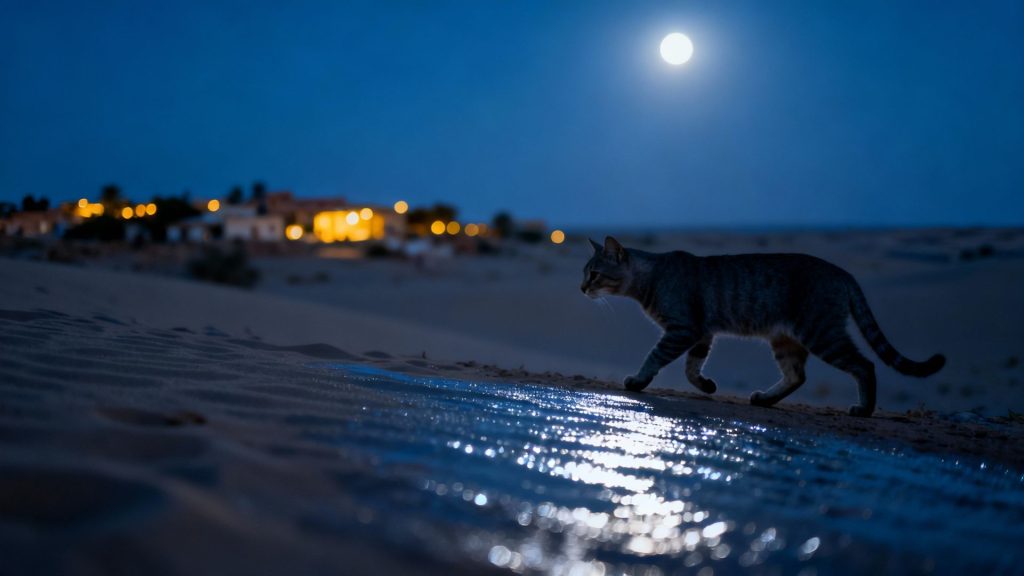
Moonlit Prowler: The Domestic Cat’s Silent Odyssey from Wild Deserts to Human Hearths
Unveiling the evolutionary marvels and survival paradoxes of Felis catus, a predator turned companion that thrives in our midst while retaining its ancestral instincts.
Imagine a twilight garden, where shadows lengthen and the air hums with unseen life; here, a domestic cat moves with liquid grace, its silhouette a whisper against the fading light. Eyes like polished obsidian scan the undergrowth, ears twitching at the rustle of a beetle, embodying an ancient vigilance forged in the deserts of North Africa. This encounter, a fleeting moment in a human-dominated landscape, reveals not just a pet, but a master of adaptation whose presence bridges the wild and the tame, inviting us into a world where instinct and domestication dance in silent harmony.
Over millennia, natural selection honed Felis catus into a nocturnal hunter, gifting it retractable claws that sheath like daggers and tapetum lucidum eyes that amplify the faintest moonbeam, transforming darkness into a canvas for predation. These traits, sculpted by the arid challenges of its ancestral home, Felis silvestris lybica, enabled survival through stealth and efficiency, a testament to evolution’s relentless blade that carves precision from necessity, ensuring each pounce is poetry in motion.
In the rhythm of daily existence, the cat’s survival unfolds as a meticulous ballet: stalking rodents with coiled tension, leaping with acrobatic finesse, and conserving energy through long hours of rest. This hunter thrives not only in rural barns but urban alleys, where its role as a pest controller weaves it into the fabric of human settlements, a silent guardian whose predatory prowess remains undimmed by the comforts of home.
Reproduction in Felis catus is a cycle of fierce independence and tender nurture; females, solitary by nature, seek secluded dens to birth litters of two to six kittens, their milk-rich care a fortress against early mortality. Kittens emerge blind and helpless, yet within weeks, play-fights mimic future hunts, a primal education passed down not through social bonds but through instinctive mimicry, ensuring the lineage’s resilience in a world of flux.
As an ecological linchpin, the domestic cat exerts profound influence, curbing rodent populations that might otherwise ravage crops and spread disease, yet this benefit is shadowed by its invasive impact on native birds and small mammals. In ecosystems worldwide, it stands as both a guardian and a disruptor, a paradox that underscores the delicate balance between human companionship and unintended ecological consequences.
Today, Felis catus faces threats not from wilderness but from abundance: overpopulation leads to feral colonies suffering disease and starvation, while habitat loss fragments its domains. Conservationists, like those documented in global wildlife reports, advocate for responsible ownership and trap-neuter-return programs, turning potential despair into pragmatic steps toward coexistence, where every spayed cat is a small victory for harmony.
In the cat’s quiet persistence, we glimpse the eternal dialogue between nature and nurture—a reminder that even in our homes, the wild endures, teaching resilience and humility. This small predator, once a desert ghost, now mirrors our own journey, urging reflection on how we might share this planet with grace, honoring the ancient rhythms that pulse beneath the veneer of domestication.