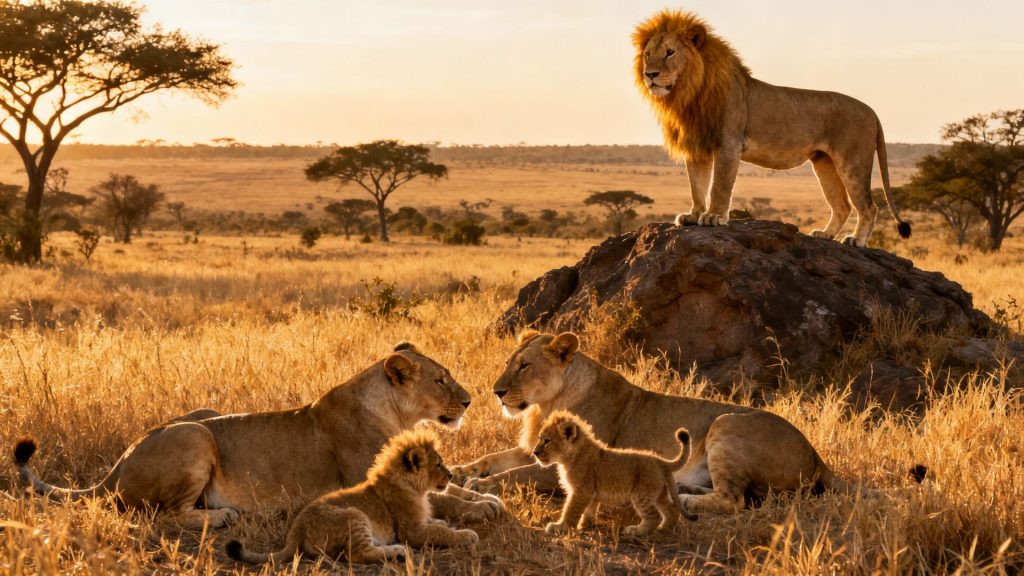
Golden Sovereigns of the Savanna: Lions, Weaving Threads of Predation and Kinship Beneath the African Sun
Exploring how Africa’s apex predators master the art of survival through complex social bonds and relentless hunting prowess, yet face encroaching shadows of human expansion across their dwindling realms.
In the first light of dawn, the Serengeti awakens to a primal symphony: a lioness emerges from the golden grass, her silhouette cutting through the mist like a blade. Her amber eyes scan the horizon with a stillness that belies the storm within. This is no mere animal; it is the living heartbeat of the savanna, a force that commands the earth and sky in a single, unblinking gaze. Here, in the vast expanse where life pulses raw and unfiltered, we witness the beginning of a timeless saga.
Evolution has sculpted Panthera leo into a masterpiece of predation. Their retractable claws, silent as shadows, evolved over millennia to grip fleeing prey, while powerful jaws deliver a bite force of 650 psi, a gift from natural selection’s relentless forge. Sociality became their shield; unlike solitary cats, lions form prides where collective strength offsets individual vulnerability. This adaptation, born in Pleistocene grasslands, allows them to dominate landscapes where isolation spells demise.
Daily existence unfolds as a meticulous dance of survival. Lionesses orchestrate hunts with military precision, using tall grass as cover to stalk wildebeest. Each chase is a gamble of energy conservation. A successful kill feeds the pride, but failures demand rest beneath acacia trees. Males patrol territories, roaring to warn rivals. This vigilance maintains balance, preventing overgrazing by herbivores. Such routines are not mere instinct but calculated artistry, honed by generations in the wild.
Bloodlines endure through profound kinship. Lionesses synchronize births, creating creches where cubs nurse communally. Females teach young hunting skills over months, while males defend against infanticidal intruders. This investment ensures genetic legacy; a pride’s cohesion can span decades. Yet, mortality looms. Only half of cubs reach adulthood, their survival dependent on environmental stability and maternal prowess.
Ecologically, lions reign as keystone species. By regulating herbivore populations, they prevent habitat degradation, fostering biodiversity. Their presence signals ecosystem health, influencing species from vultures to beetles who scavenge their kills. Without them, savannas would unravel into chaos. This role makes lions not just predators but architects of their world, sculpting life cycles with each hunt.
Modern threats cast long shadows. Habitat loss fragments prides, as farmlands replace wild corridors. Human-wildlife conflict leads to retaliatory killings. Climate shifts alter prey migration, starving prides. Conservationists like Paula Kahumbu report hope: Kenya’s lion population stabilized by 15% via community-based initiatives. But challenges persist. Genetic diversity dwindles in isolated groups, a silent crisis demanding urgent science-backed solutions.
In lion society, we glimpse nature’s contradictions: fierce independence bound by communal duty, strength tempered by fragility. They remind us that survival is not conquest but harmony. As the sun sets over the savanna, their roars echo a universal truth—every thread in life’s tapestry, from predator to prey, weaves a story of resilience. In their eyes, we find reflections of our own existence: fleeting yet eternal, vulnerable yet indomitable.