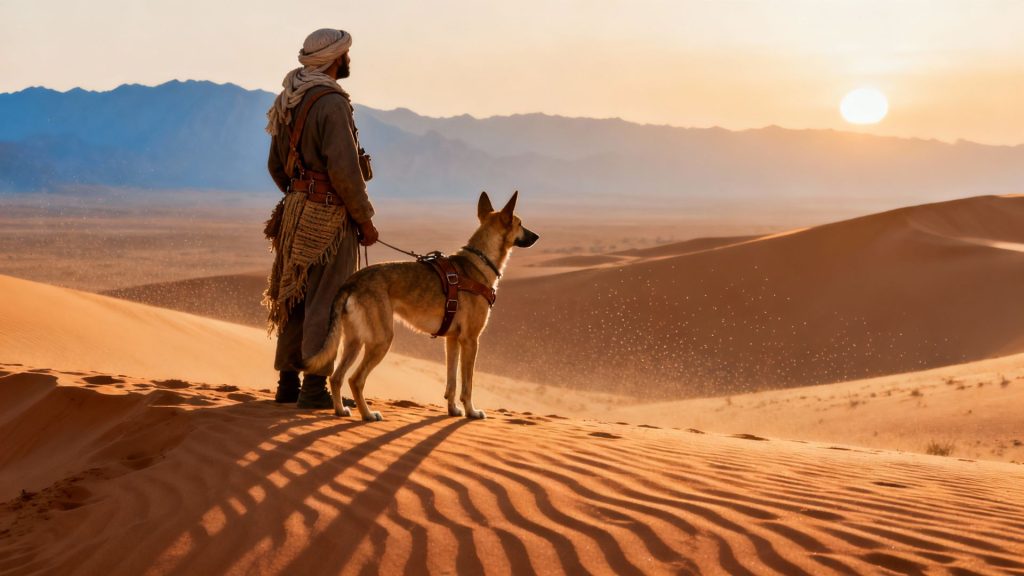
Silent Sentinels of Civilization: The Dog, Our Ancient Ally in the Human Journey
Through millennia of domestication, dogs have honed extraordinary senses and unwavering devotion, evolving from wild predators to vital partners in human emotional and physical survival.
As dusk descends upon a tranquil meadow, the silhouette of a canine emerges—a creature whose presence bridges the chasm between wilderness and home, evoking a primal awe. In this imagined encounter, the rustle of grass underfoot and the distant chorus of crickets frame the dog’s silent vigilance, its amber eyes reflecting the dying light, embodying a timeless guardian spirit. This first brush with canine essence invites us into a world where loyalty is etched in every gesture, a world sculpted by eons of shared history and mutual reliance. We stand not as observers but as participants in a narrative that began 15,000 years ago, when wolves first approached human encampments, drawn by the promise of warmth and scraps—a bond forged in the crucible of necessity.
The transformative blade of natural selection honed the dog into a biological marvel; its keen olfactory senses, capable of detecting parts per trillion, and acute hearing, tuned to frequencies beyond human range, became tools for survival. Genetic studies reveal how selective breeding amplified traits like empathy and intelligence, shrinking the cranium and refining the brain for social cognition. This evolutionary journey, chronicled through fossil records from sites like Bonn-Oberkassel in Germany, showcases the dog’s adaptation not through brute force but through symbiotic partnership. Over generations, these changes crystallized into a form perfectly attuned to human cues—whispering of a silent language that transcends speech, where a tilt of the head or a wagging tail speaks volumes.
In the rhythm of daily existence, the dog’s survival poetry unfolds: a border collie marshaling sheep with precision, a retriever fetching amid crashing waves, or a terrier digging with instinctual fervor. These acts, rooted in ancestral hunting strategies, now serve as choreographed dances of cooperation. Unlike solitary predators, dogs thrive in collaborative endeavors, their energy channeled into tasks that mirror human needs—herding, guarding, and companionship. This behavioral symphony, documented in ethological research, underscores how domestic life reshaped but never erased their wild essence. Each bound across a field or patient wait at a door is a testament to an unbroken lineage of adaptability, where instinct and nurture intertwine.
Within the tapestry of canine life, bonds of blood echo; the alpha dynamics of wolf packs evolved into intricate family units, where matriarchs nurture pups through communal care. Selective breeding has diversified social structures—from the independent husky to the affectionate labrador—yet shared traits like maternal devotion remain universal. Reproduction studies, such as those from the University of Vienna, highlight how synchronized breeding cycles and vocalizations foster cohesion. This continuity of kinship, where generations pass on learned behaviors, anchors the dog in a network of relationships that mirrors human families, offering lessons in resilience and unconditional support.
As ecological keystones, dogs anchor ecosystems beyond the home; as service animals, they detect seizures or guide the blind, their sensory gifts saving lives in disaster zones and hospitals. Scientific assessments, including reports from the Assistance Dogs International network, illustrate their role as non-human engineers of human environments—enhancing mental health and security. Without them, human societies might falter, their absence leaving voids in emotional support and practical aid. This symbiotic footprint, from farmyards to urban jungles, cements their status as indispensable threads in the fabric of civilization.
Yet shadows loom in the canine chronicle: threats like irresponsible breeding leading to genetic disorders or abandonment crises surge globally. Conservation efforts, such as those championed by international shelters, offer hope—vaccination drives curb rabies, and adoption initiatives reduce stray populations. These challenges, starkly outlined in veterinary journals, remind us of the fragility that accompanies interdependence. By confronting overpopulation and zoonotic risks, we honor the bond, turning despair into action for a future where every bark echoes in safety.
In this eternal dialogue, dogs embody nature’s wisdom—a mirror to human virtues of loyalty and adaptability. Their journey, from fire-lit camps to modern sofas, teaches that coexistence is not dominion but harmony. As scientist Jane Goodall reflects in her writings, they remind us of our place in the web of life, urging reflection on stewardship. Through their eyes, we glimpse the essence of wildness tamed yet untamed—a paradox that fuels our reverence for all living things.