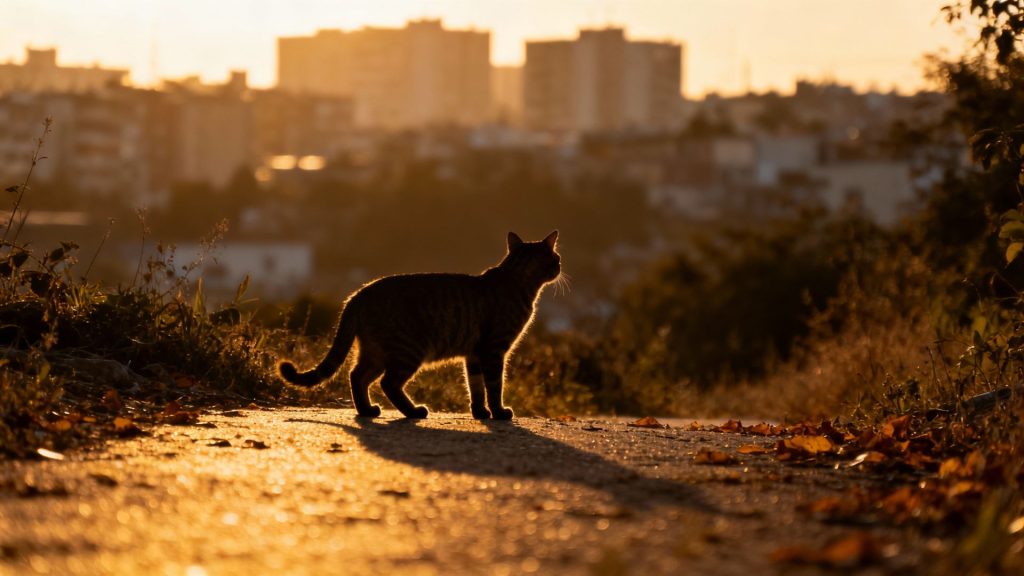
Twilight Architects of Solitude: Cats, Guardians Between Wild Whispers and Human Worlds
Descended from desert predators, they navigate urban labyrinths with ancient instincts, their silent grace a testament to evolution’s artistry and the tensions of coexistence.
As the last hues of dusk fade over a forgotten alley, a shadow emerges—fluid, deliberate—piercing the stillness with eyes like liquid embers. This is the cat, a solitary sentinel in the concrete expanse, where the wild soul of its ancestors lingers, poised between the rustle of leaves and the hum of humanity. In this moment, the world shrinks to a single point of focus: the untamed presence, a reminder of nature’s enduring mystique amidst our ordered chaos.
Evolution’s hand has crafted cats into masters of nocturnal pursuit. Their vertically slit pupils expand to capture scarce photons, turning darkness into a canvas for ambush; retractable claws, spring-loaded by millennia of natural selection, allow for silent, precise strikes. Flexible spines grant acrobatic agility, enabling escapes through narrow crevices—adaptations forged in arid landscapes, where survival hinged on stealth. These physiological marvels, refined over epochs, render the domestic cat a living sculpture of predatory efficiency, a blend of sinew and instinct.
Daily existence unfolds as a tactical ballet, where patience becomes a weapon. Cats stalk through urban undergrowth or vacant lots, bodies low, muscles coiled—a sequence of measured movements culminating in explosive pounces. Hunting, even in play, is a ritual of focus: tail twitches as a counterbalance, whiskers map unseen obstacles. This subsistence strategy, energy-efficient and opportunistic, sustains them where rodents scurry unseen, a dance of survival honed in deserts and now transposed to pavement.
Reproduction and kinship reveal a paradoxical intimacy. Females, after weeks of gestation, retreat to hidden nests—under porches or in tangled shrubbery—to birth litters. They nurture kittens with rigorous devotion, cleaning and guiding them through early hunts. Social bonds form through subtle hierarchies: mutual grooming strengthens alliances, yet independence reigns, a legacy of their solitary origins. Through this, life’s fragile thread extends, kittens learning the art of evasion and dominance in a world indifferent to vulnerability.
In ecosystems reshaped by humans, cats assume a critical, contentious role. As mesopredators, they control burgeoning rodent populations, curbing disease vectors and agricultural damage in urban sprawls. Yet, their presence stirs ecological friction, where introduced populations may decimate native birds and small mammals, sparking debates on biodiversity conservation. This duality underscores their position as ecosystem engineers, balancing pest control with unintended consequences in fragmented habitats.
Current threats shadow their survival. Habitat loss fragments territories, forcing perilous crossings through traffic; diseases like feline leukemia and immunodeficiency virus spread through fights or dense colonies. Urbanization erodes natural behaviors, while ethical dilemmas arise from confinement versus innate wildness. Conservation efforts focus on trap-neuter-return programs and disease management, fostering coexistence without romanticizing the challenges, a pragmatic approach to preserving their legacy.
In their quiet resilience, cats mirror nature’s profound truths. They embody the paradox of strength in fragility, thriving in human shadows while retaining wild essence. Their existence whispers of adaptation’s genius, urging us to reflect on coexistence: that in the dance between domestication and freedom, lies a universal lesson on harmony, inviting reverence for life’s intricate web.