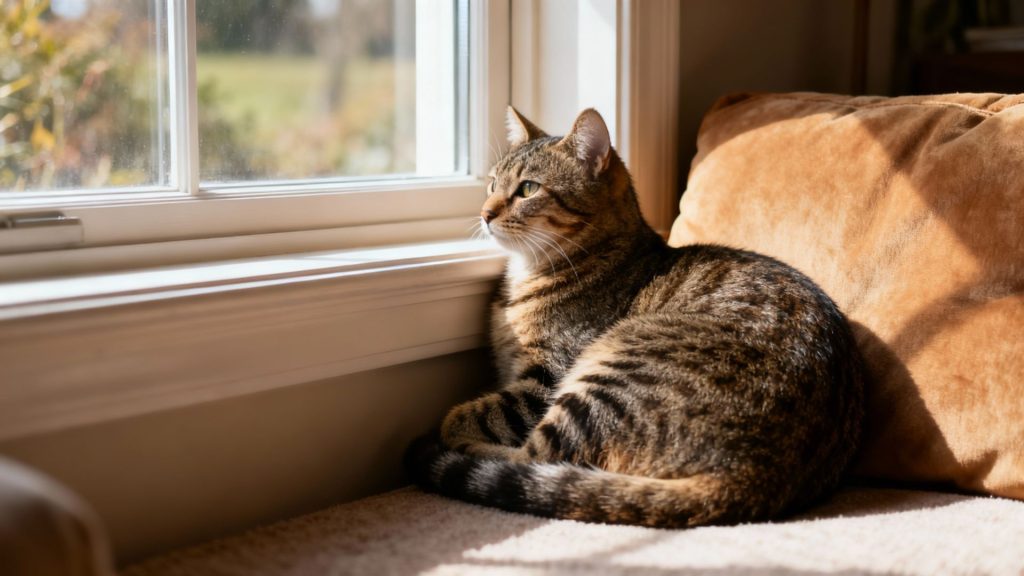
Whispering Shadows: The Domestic Cat’s Silent Dance Between Wild Instinct and Human Hearth
Descendants of ancient desert hunters, domestic cats retain their predatory brilliance, reshaping ecosystems and forging deep human bonds while confronting modern perils of overpopulation and habitat fragmentation.
In the fading twilight of a Mediterranean coastline, a silhouette emerges—graceful, elusive, and utterly silent. The domestic cat, Felis catus, moves with the fluidity of a shadow, its amber eyes piercing the dusk like beacons of ancient wilderness. Here, where wild thyme scents the air and cicadas hum their evening chorus, the cat stalks through sun-bleached grasses, a primordial predator reborn in our midst. This moment captures the essence of a creature that bridges epochs: part wild spirit, part comforting presence, evoking awe in its effortless mastery of terrain and time.
Forged by millennia of natural selection, the domestic cat’s evolutionary triumphs lie in its sensory arsenal. Night vision, enhanced by a tapetum lucidum reflecting light, transforms darkness into a hunting ground, while whiskers, sensitive as seismic sensors, map unseen obstacles. Such adaptations, honed in the arid landscapes of its African wildcat ancestors, enable precision in predation—a blade sharpened by survival. Every leap and pounce echoes an ancient dance, where missteps meant starvation, and success etched resilience into genetic memory.
Survival for this feline artist unfolds in a daily symphony of instinct and adaptation. Hunting is not mere necessity but an art form: stalking with liquid stealth, employing bursts of speed to ambush prey, and caching kills as insurance against scarcity. Play mimics these rituals, sharpening skills in kittenhood and sustaining agility into adulthood. Yet, the domestic realm adds layers—affectionate head-butts, purring contentment on laps—a juxtaposition that reveals an innate flexibility, allowing cats to thrive in diverse habitats from urban alleys to rural barns.
Reproduction and kinship weave the fragile threads of continuity. Solitary by heritage, cats form transient bonds during mating seasons, with females selecting mates through vocal duets and scent markings. Gestation yields litters of blind, helpless kittens, nurtured in hidden dens where maternal devotion shines—cleaning, feeding, and teaching through gentle nips. This intimate cycle, though brief, underscores life’s tenacity, as offspring disperse to carve new territories, perpetuating a lineage shaped by both isolation and occasional camaraderie.
As an ecological architect, the domestic cat wields profound influence. Introduced globally, it reshapes food webs: controlling rodent populations in grain stores yet devastating native birds and small mammals, a paradox that casts it as both ally and invasive threat. Studies reveal its role as a mesopredator, capable of altering biodiversity patterns, yet its presence in human settlements also fosters pest management, illustrating the delicate balance of coexistence in shared landscapes.
Modern perils cast long shadows over this resilient species. Urbanization fragments habitats, exposing feral colonies to disease and traffic, while unchecked breeding strains resources, leading to euthanasia in shelters. Conservation efforts, like trap-neuter-return programs, offer hope, mitigating overpopulation without eradicating the wild spirit that defines cats. These challenges reflect broader human impacts, yet they ignite dialogues on ethical stewardship, urging solutions that honor both feline independence and ecological harmony.
In the domestic cat, we glimpse nature’s enduring dialogue—a testament to evolution’s artistry and the fragile interdependence of life. Its silent prowl through our homes mirrors humanity’s own journey: a quest for balance between dominion and humility. As shadows lengthen, the cat remains an ambassador of wilderness, reminding us that true companionship lies in respecting the untamed heart within the hearth, forever challenging us to listen to the whispers of the wild.