Whispers in the Moonlight: The Domestic Cat, a Silent Symphony of Instinct and Grace in Our Shared World
From ancient desert origins to modern hearths, the cat’s evolutionary mastery in sensory perception and hunting defines its role as a resilient survivor, navigating the delicate balance between wild independence and human companionship.
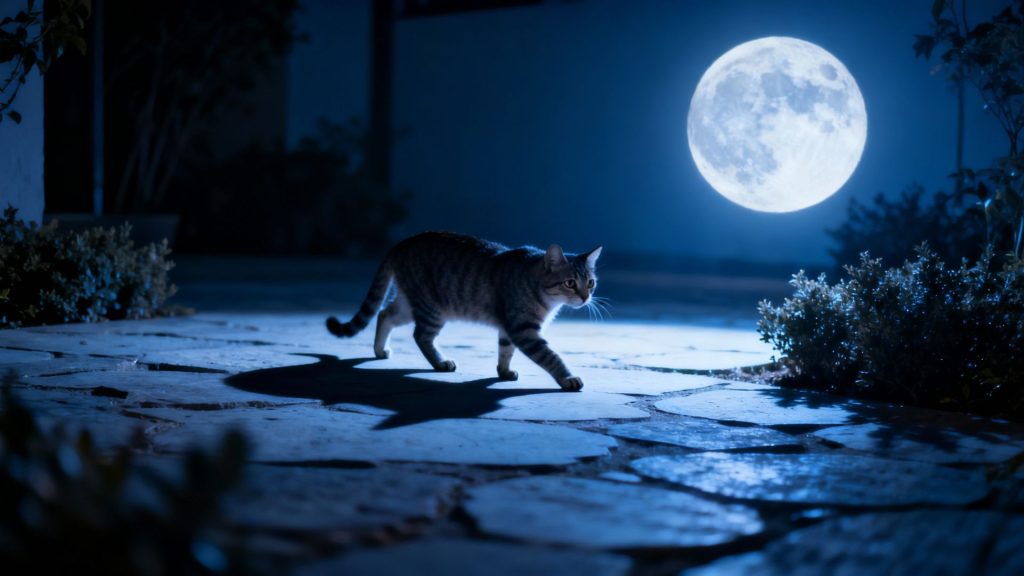
Imagine the hush of twilight in a suburban garden, where a shadow slips through the tall grass—a domestic cat, Felis catus, emerges with fluid stealth, its eyes catching the fading light like twin lanterns. This creature, descended from the African wildcat, embodies a paradox: a solitary hunter now curled on our sofas, its presence a silent echo of millennia-old adaptations. In this first encounter, the cat moves with a predator’s precision, muscles coiled beneath a sleek coat, evoking a primal connection to the wild. The air hums with the scent of earth and prey, as the cat surveys its domain, a living testament to the enduring alliance between humanity and nature. Here, in the quiet intimacy of dusk, we witness the essence of a species that has journeyed from arid landscapes to our hearths, its every step a dance of survival and serenity.
The cat’s evolution is a masterpiece of natural selection, forged in the crucible of survival. Its retractable claws, honed for silent stalking, allow it to traverse diverse terrains without a sound, while the tapetum lucidum—a reflective layer behind the retina—amplifies dim light, transforming night into a canvas for hunting. This adaptation, coupled with acute hearing that detects ultrasonic frequencies beyond human range, stems from ancestral pressures in the deserts and savannas. Over 10,000 years of domestication, these traits have persisted, enabling the cat to thrive in urban jungles as a consummate predator. The whiskers, or vibrissae, serve as precise spatial sensors, guiding it through narrow spaces with unerring accuracy. Such physiological marvels are not mere quirks but evolutionary blades, sharpened by the need to ambush rodents and evade larger predators, illustrating how the cat became a master of its environment through relentless refinement.
In the daily tapestry of existence, the cat’s survival strategies unfold as a poetic ritual. Each dawn, it engages in meticulous grooming, a behavior that maintains insulation and scent camouflage, while its hunting instincts manifest in playful pounces on toys or earnest stalks of insects. The cat employs a sequence of crouch, stalk, and lethal bite—a technique preserved from wild ancestors—ensuring efficient capture of prey. This is no idle pastime but a vital expression of innate drives, sustaining energy for solitary patrols. Dietary habits reflect opportunistic omnivory, with cats favoring high-protein meals that fuel their high metabolism, yet they adapt to human-provided foods without losing their predatory edge. Through such routines, the cat crafts a survival poem, where instinct and adaptation intertwine, revealing a life of calculated independence in the face of changing landscapes.
Reproduction and social bonds in cats weave a narrative of continuity and care. Females, known as queens, enter estrus cycles triggered by seasonal light changes, emitting pheromones that attract toms in a ritual of courtship calls. Mating induces ovulation, leading to litters of 3-5 kittens born blind and dependent. Maternal care is profound: the queen licks her young to stimulate breathing and nurses them, teaching hunting skills through mock battles as they grow. While often solitary, cats form loose colonies in resource-rich areas, communicating through vocalizations, body postures, and scent marking. This social flexibility, observed in feral groups, highlights a nuanced balance between isolation and community, where kinship ensures the transmission of survival wisdom. The bond between mother and offspring, fleeting yet intense, underscores the species’ resilience, as each generation inherits the legacy of adaptation.
As an ecological cornerstone, the cat occupies a dual niche in human-altered ecosystems. Historically, it served as a natural pest controller, reducing rodent populations in agricultural settings, a role that persists in modern homes. Yet, as an introduced species, its predatory impact on native birds and small mammals poses challenges, emphasizing its position as both a beneficiary and a disruptor. In urban environments, cats act as indicators of ecosystem health, their presence reflecting habitat quality and human-wildlife interactions. This duality invites reflection on coexistence: the cat’s integration into our lives mirrors broader themes of biodiversity, where its role as a companion species underscores the interconnectedness of all life, urging responsible stewardship to mitigate unintended consequences.
Today, the cat faces threats that test its evolutionary fortitude. Diseases like feline immunodeficiency virus and abandonment due to overpopulation endanger populations, while habitat fragmentation limits genetic diversity. Conservation efforts, led by organizations promoting spaying and neutering, offer hope, reducing stray numbers and enhancing welfare. The cat’s story is not one of despair but of enduring adaptability; it thrives in diverse settings, from bustling cities to rural farms. In this twilight of challenges, we find a dawn of resilience—a reminder that life’s fragility is matched by its tenacity. The domestic cat, with its quiet grace, teaches us about the beauty of survival, the importance of balance, and the profound dialogue between humanity and the natural world, inspiring a deeper reverence for the wild within our walls.