Whispers in the Twilight: The Domestic Cat, an Eternal Enigma of Solitary Grace and Silent Hunts
From ancient desert origins to modern hearths, this feline navigates independence and companionship, facing urbanization with resilience while embodying nature’s predatory elegance.
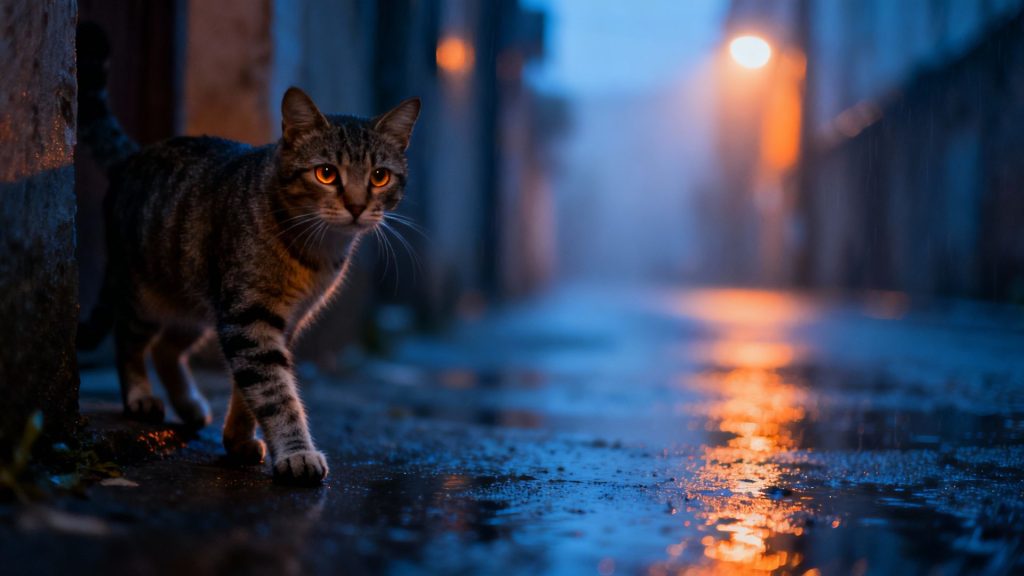
As dusk settles over a quiet garden, shadows deepen and a figure emerges – a domestic cat, its silhouette a study in fluid motion. Eyes like polished amber catch the fading light, scanning the undergrowth with ancient vigilance. In this liminal space between day and night, the cat moves with predatory silence, each step a whisper on the dew-kissed grass. The air holds the scent of earth and possibility, and in this moment, we are granted a glimpse into a world ruled by instinct, where every rustle speaks of unseen prey and every pause resonates with primal awareness. This is not merely an animal; it is a living testament to millennia of evolution, a ghostly presence in our domesticated landscapes.
Forged by the relentless pressures of natural selection, the cat’s nocturnal adaptations are marvels of biological engineering. Its eyes, equipped with a tapetum lucidum, transform the faintest moonlight into a navigable terrain, granting vision six times more sensitive than our own. Ears swivel independently, capturing the minutest sounds – the scurry of a mouse hidden beneath leaves, the flutter of insect wings – while whiskers map the dark like tactile sonar. These features are not accidents but evolutionary solutions, sculpted over 10,000 years since its divergence from wild ancestors in the Near East. The cat’s retractable claws, sheathed in velvet silence, exemplify nature’s precision: tools for climbing, killing, and retreat, all honed through survival in diverse habitats from arid deserts to dense forests.
Daily existence unfolds as a rhythmic poem of survival and play. At dawn, the cat engages in meticulous grooming, its raspy tongue a natural comb that maintains insulation and camouflage. Hunting rituals dominate its twilight hours – a crouch, a stalking approach, and the explosive pounce perfected through juvenile play. This behavior, rooted in solitary predation, sees the cat consume small vertebrates and insects, its metabolism finely tuned for frequent, small meals. Yet, even in domesticity, remnants of wildness persist: the instinct to cache leftovers, the territorial patrolling marked by scent glands on cheeks and paws. Such routines are not mere habits but elegies to an ancestral life, balancing efficiency with innate curiosity.
In the delicate dance of reproduction, the cat reveals a complex interplay of solitude and nurture. Females enter estrus multiple times yearly, signaling availability through plaintive calls and pheromones. After a brief courtship, gestation lasts 65 days, culminating in a hidden den where 3-5 blind kittens arrive. Here, the mother embodies selfless dedication: nursing, cleaning, and teaching hunting skills through live prey demonstrations. Kittens learn critical survival tactics by 8 weeks, yet this bond is transient; as independence blooms, the family unit dissolves into the cat’s quintessential solitariness. This paradox – intense maternal investment followed by dispersal – ensures genetic diversity while minimizing competition in shared territories.
Ecologically, Felis catus occupies a dual role, both as a natural pest controller and a paradoxical disruptor. Historically valued in agrarian societies for rodent suppression, it curtails disease vectors like rats and mice, benefiting human settlements. However, as an invasive predator introduced globally, free-roaming cats now threaten native biodiversity, particularly on islands where they decimate bird populations. Their presence alters ecosystems, serving as both unintended indicators of human encroachment and accidental agents in the decline of vulnerable species. This duality underscores the cat’s ecological footprint: a companion species whose wild heart still influences the balance of life beyond our homes.
Contemporary challenges cast long shadows over this resilient species. Urbanization fragments habitats, exposing indoor cats to obesity and stress-related ailments, while outdoor populations face vehicle collisions, disease, and conflicts with wildlife. Feline immunodeficiency virus and leukemia loom as persistent threats, exacerbated by overpopulation in stray colonies. Conservation efforts, led by organizations like the International Union for Conservation of Nature, emphasize managed sterilization programs and public education to mitigate harm. Yet, amidst these trials, the cat’s adaptability shines – it thrives across six continents, its global population estimated at 600 million, a testament to evolutionary tenacity in an anthropocentric era.
In the silent communion between human and cat, we find profound lessons on autonomy and coexistence. This creature, shaped by millennia of solitude, offers no submission but chooses companionship on its terms. Its independence mirrors nature’s untamed spirit – a reminder of resilience in fragmented worlds. As stewards of this shared planet, we are called to honor the cat’s wild essence: to protect its freedom while safeguarding biodiversity. Through its eyes, we glimpse the delicate threads binding predator and prey, solitude and society, urging us toward greater ecological harmony. In the cat’s quiet dignity, nature whispers truths of adaptation and endurance.