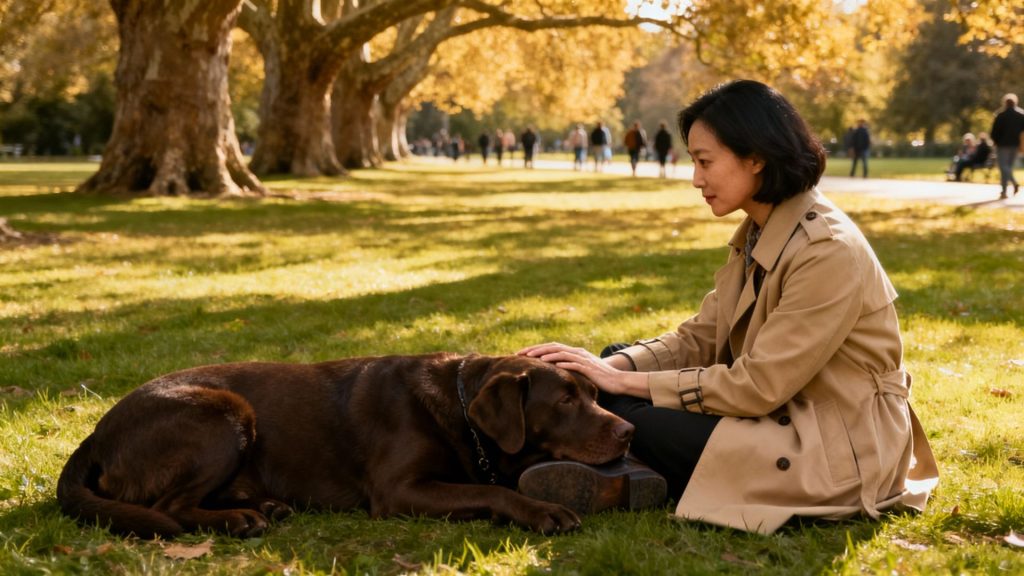
Whispers of Loyalty: The Canine Soul, Weaving Bonds Across the Ages of Human Civilization
From Ancient Wolves to Modern Hearth: How Dogs Forged an Unbreakable Alliance in the Crucible of Human History
Imagine standing at the edge of a primordial forest, where the first light of dawn filters through ancient oaks, and there, emerging from the mist, a silhouette moves with silent grace—a descendant of wolves, now transformed into humanity’s eternal companion. Its amber eyes hold millennia of untamed wilderness, yet radiate an instinctive trust that bridges the chasm between species. This initial encounter, a fleeting moment in nature’s theater, reveals the dog not as a mere pet, but as a living testament to an evolutionary pact forged in the crucible of survival. The air hums with the scent of damp earth and pine, evoking a visceral connection to the wild origins that still pulse beneath its domesticated veneer.
In the grand narrative of natural selection, dogs wield the blade of adaptation with unparalleled finesse, sculpted over 15,000 years from gray wolves into masters of sensory perception. Their olfactory bulbs, forty times more sensitive than humans’, detect scents at parts per trillion, a gift honed for tracking prey across vast landscapes. This evolutionary marvel extends to their auditory range, capturing frequencies beyond human hearing, allowing them to anticipate storms or distant threats. Such traits were not random gifts but forged through relentless pressure: wolves that ventured near human camps gained scraps, surviving where solitary hunters perished. This symbiosis birthed breeds like the Siberian Husky, whose double coat insulates against Arctic blizzards, embodying nature’s precision in every strand of fur.
Daily life for dogs unfolds as a poetic dance of survival, where instinct and learned behavior intertwine in harmonious rhythm. In urban parks or rural fields, they employ sophisticated foraging strategies, such as caching food for lean times—a vestige of ancestral scarcity. Social hierarchies emerge in play, where mock battles strengthen bonds and establish order without violence, reflecting a complex language of body postures and vocalizations. Their hunting prowess, though often dormant, surfaces in the chase of squirrels or balls, a reminder of the wild persistence that once secured meals. This existence is not mere routine but a testament to resilience, where each wag of a tail or alert bark echoes the ancient pulse of survival against all odds.
The tapestry of canine life is woven with threads of kinship, where reproduction and nurturing reveal profound biological wisdom. Females enter estrus twice yearly, timing births to seasons of abundance, while males exhibit fierce loyalty in guarding dens. Puppies, born blind and helpless, thrive under meticulous care: mothers regurgitate pre-digested food, teaching pups through gentle nuzzles, a behavior observed in wild canids like African painted dogs. This familial bond extends beyond bloodlines, as dogs form lifelong attachments to human families, their pack mentality repurposed for communal harmony. Studies of feral dog populations show cooperative breeding, where non-parents assist in rearing young, underscoring an innate drive for collective survival that mirrors humanity’s own social evolution.
As ecological linchpins, dogs transcend their role as companions to become indicators of environmental health and human well-being. In ecosystems, they control rodent populations, preventing crop devastation, while their presence in disaster zones as search-and-rescue partners saves countless lives. Yet this alliance faces twilight threats: overbreeding leads to genetic disorders like hip dysplasia, and urban sprawl creates legions of strays vulnerable to disease and neglect. Conservation efforts, such as spay-neuter programs documented in global news, offer a dawn of hope, reducing euthanasia rates by 30% in regions like Europe. This duality—strength entwined with fragility—invites reflection on our shared vulnerability and the imperative to safeguard this bond for future generations.
In the silent dialogue between species, dogs embody the eternal paradox of dependence and independence, teaching humanity humility through unwavering devotion. Their journey from wild predators to bedside guardians illuminates the essence of adaptation—not as conquest, but as mutual evolution. As we gaze into their eyes, we see not just a pet, but a mirror to our own quest for connection in an indifferent universe, a reminder that true resilience lies in embracing interdependence, where every bark whispers a lesson in coexistence.