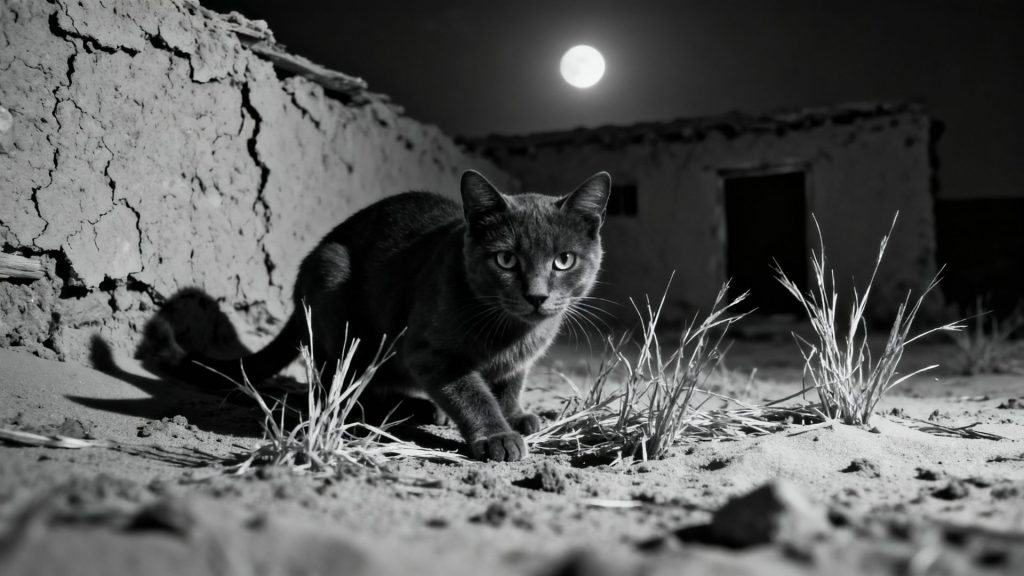
Whispers of the Desert Night: The Domestic Cat, a Silent Symphony of Instinct and Grace in Our Midst
From its ancient roots as a solitary hunter in arid landscapes to its modern role as a beloved household sentinel, the cat embodies the eternal dance between wild resilience and domestic harmony.
Imagine a moonlit garden, where shadows dance like liquid obsidian, and there, poised on silent paws, a domestic cat emerges—a creature of such fluid elegance that it seems woven from the night itself. Its eyes, twin pools of reflected starlight, scan the darkness with predatory precision, while its lithe form moves with a grace that defies gravity, a testament to millennia of evolutionary refinement. In this moment, the cat is not merely a pet but a living echo of untamed wilderness, inviting us into a world where every rustle of grass holds the promise of ancient secrets.
Forged by the relentless pressures of natural selection, the cat’s most extraordinary adaptations lie in its sensory arsenal and hunting prowess. Its ears rotate independently, capturing the faintest whisper of a mouse’s scurry—a trait honed in the deserts of North Africa, where survival demanded acute auditory perception. Similarly, its retractable claws and powerful hind legs, evolved for explosive bursts of speed, transform even a suburban backyard into a stage for primal drama, illustrating how form follows function in the crucible of adaptation.
Daily existence for the cat is a masterclass in efficiency and instinct, where hunting rituals blend seamlessly with domestic routines. It stalks imaginary prey in play, rehearsing the pounce-and-kill sequence ingrained in its DNA, while its nocturnal nature ensures it thrives under cover of darkness. This survival poetry extends to its meticulous grooming, a self-preserving act that maintains insulation and camouflage, turning mundane moments into meditations on resilience.
In the realm of reproduction, the cat reveals complex social dynamics, often forming loose colonies where females share nursing duties, demonstrating communal care that belies their solitary reputation. Kittens, born blind and helpless, are nurtured with fierce devotion—a cycle of life that underscores the species’ adaptability, as it balances prolific breeding with the challenges of urban survival.
As an ecological linchpin, the domestic cat now serves a dual role: in human homes, it curbs rodent populations, acting as a natural pest controller, while feral descendants influence local ecosystems, sometimes disrupting native wildlife. This duality highlights its unintended impact, reminding us that even the most integrated species carries the weight of its wild heritage.
Yet, the cat faces threats that mirror humanity’s footprint—overpopulation, habitat fragmentation, and diseases like feline leukemia. Conservation efforts, led by organizations documented in global news, focus on trap-neuter-return programs, offering a pragmatic path to coexistence without romanticizing the struggle.
Ultimately, the cat’s journey speaks to a profound truth: in its quiet independence and enduring adaptability, it reflects our own quest for balance between civilization and nature. It teaches that true companionship arises not from domination but from mutual respect, a silent pact written in the language of survival and shared space.