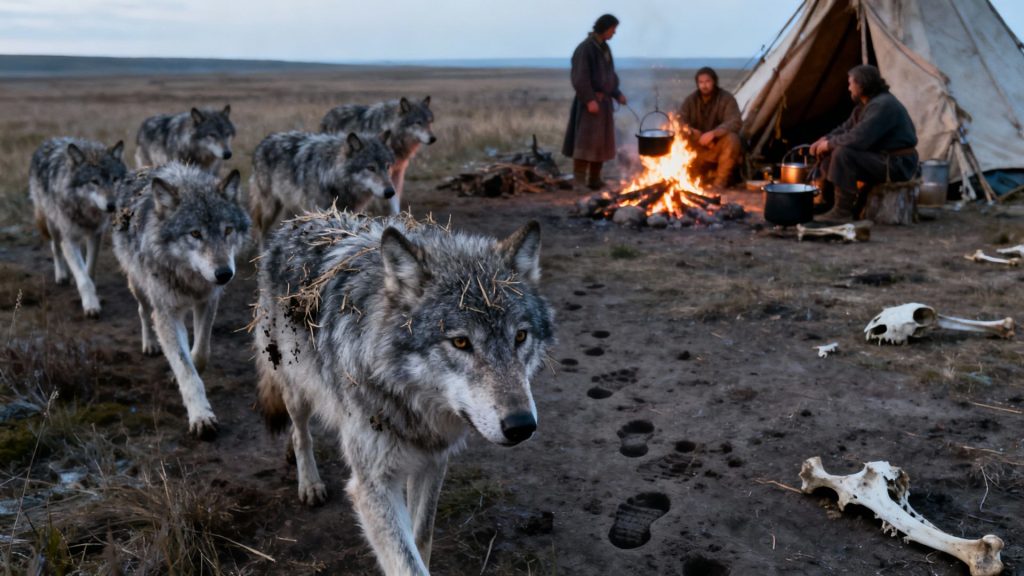
Echoes of the Pack: The Dog’s Evolutionary Saga from Wilderness to Hearth
From ancient wolf ancestors to modern companions, the dog’s journey embodies co-evolution, its keen senses and social bonds reshaping human history and ecosystems across millennia.
Imagine standing on the edge of a windswept tundra at dawn, where the first light reveals a silhouette moving with silent grace—a descendant of wolves, now domesticated, yet still carrying the wild in its gaze. This is the domestic dog, Canis lupus familiaris, emerging from the mist like a living relic of ice-age epochs. Its presence, a blend of primal alertness and gentle curiosity, evokes a profound connection to untamed landscapes, where every rustle in the grass whispers of shared ancestry. In this moment, the dog is not merely a pet but a bridge to forgotten wilderness, its amber eyes reflecting millennia of survival and adaptation.
Forged by the relentless pressures of natural selection, the dog’s most extraordinary adaptations lie in its sensory prowess and behavioral flexibility. Its olfactory system, with up to 300 million scent receptors—compared to a human’s mere 6 million—transforms the world into a tapestry of invisible trails, a legacy from wolf ancestors who relied on scent for hunting in vast territories. This evolutionary blade, honed over 15,000 years of domestication, also includes heightened auditory acuity, allowing it to detect frequencies beyond human range. Such traits were sculpted not by chance but by the crucible of ice-age survival, where only the most attuned could thrive in shifting environments, turning the dog into a master interpreter of nature’s subtle cues.
In the daily theater of survival, the dog employs strategies that blend ancient instincts with modern adaptability. As opportunistic omnivores, they exhibit a versatile diet, scavenging or hunting with pack-like coordination inherited from wolves—a dance of stalking, chasing, and subduing prey that now manifests in playful retrieves or vigilant guarding. Their social intelligence, evident in complex hierarchies and cooperative behaviors, enables them to navigate human-dominated worlds, from urban streets to rural farms. This survival poem unfolds in routines of territory marking, vocal communication through barks and whines, and energy-conserving rest patterns, all fine-tuned to maximize efficiency in diverse habitats, whether foraging in forests or curling by a hearth.
The tapestry of canine life is woven through intricate reproductive and social bonds, where loyalty transcends mere instinct. Breeding cycles, synchronized with seasonal abundance, see females nurturing litters with fierce protectiveness, teaching pups survival skills through play and discipline. In packs or family units, dogs display altruistic behaviors—sharing food, defending kin, and forming lifelong attachments. This web of kinship, observed in feral groups or household pets, underscores a profound biological imperative: the perpetuation of genetic lines through cooperative care, turning each generation into a testament to evolutionary resilience and emotional depth.
As an ecological keystone, the dog’s influence extends far beyond companionship, reshaping ecosystems through its role as a human symbiont. Historically, as hunters and herders, they controlled pest populations and facilitated agricultural revolutions, acting as ecosystem engineers that altered landscapes. Today, their presence in urban and rural settings affects biodiversity—from dispersing seeds to influencing predator-prey dynamics—while their status as a cultural and biological indicator species highlights environmental health. Yet, this cornerstone position is a double-edged sword, reflecting the delicate balance between domestication and wild integrity in a rapidly changing biosphere.
Despite their ubiquity, dogs face profound threats in the modern era, from abandonment and overbreeding to diseases like parvovirus and rabies. Conservation efforts, led by organizations such as the World Health Organization in rabies eradication campaigns, offer glimmers of hope through vaccination programs and ethical breeding standards. Current population trends show stability in many regions, yet challenges persist, demanding global cooperation to ensure their welfare. This twilight narrative is not one of despair but a call to stewardship, recognizing that the dog’s survival mirrors our own commitment to biodiversity and humane coexistence.
In the grand dialogue of life, the dog stands as an enduring symbol of adaptability and interconnectedness, its journey a parable for human evolution. From wilderness to home, it teaches that survival is not solitary but shared—a dance of mutual dependence that redefines resilience. As we reflect on this bond, we glimpse the essence of life’s tenacity: a reminder that in every wag of a tail or alert gaze, there lies a deeper wisdom, urging us to honor the fragile tapestry of existence that binds all species in an eternal, unfolding story.