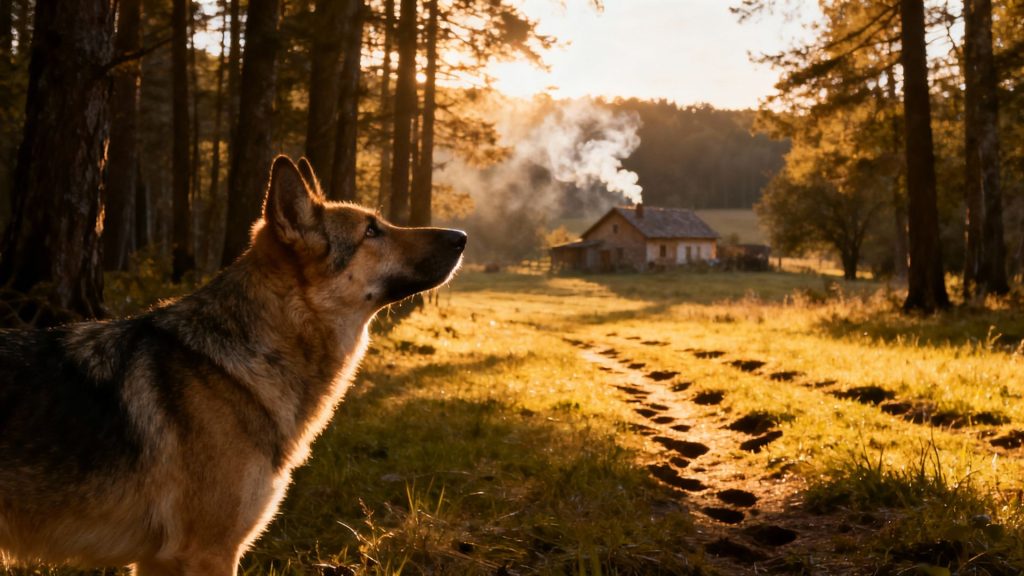
Whispers at the Threshold: The Canine Journey from Wilderness to Heart’s Companion
Traversing millennia of evolution, the domestic dog emerged as humanity’s steadfast ally, reshaping ecosystems and forging bonds that echo through human history and natural realms.
Beneath a canopy of ancient oaks, where moonlight filters through leaves like silver threads, a shadow moves with silent grace—a wolf, ancestor to all dogs, its gaze piercing the darkness. This primal scene, untouched by human hands, evokes the raw power and solitary majesty that birthed the domestic canine. Imagine the first encounters: a flicker of curiosity amidst the wilderness, where early humans and wolves shared hunting grounds, their paths converging in mutual wariness. In such moments, the foundation was laid for a partnership that would transcend species, inviting us into a world where loyalty and instinct intertwine. The air carries the scent of damp earth and pine, as the wolf’s howl echoes, a haunting reminder of origins that still resonate in every dog’s soul.
Evolution honed the dog’s most formidable tools: its olfactory prowess, capable of detecting scents diluted to one part per trillion, and its social cognition, refined through selective breeding. Over 15,000 years, natural pressures sculpted wolves into dogs—favoring traits like tameness and cooperative hunting. Genetic studies reveal mutations in genes such as WBSCR17, enhancing docility and bonding. This was no accident; it was nature’s crucible, where survival demanded adaptability. The wolf’s predatory instincts were tempered, giving rise to breeds that excel in companionship, their senses sharpened not for solitary conquest, but for shared endeavors with humans.
In the tapestry of daily survival, dogs weave intricate strategies: from scent-tracking prey to guarding homesteads, their behaviors mirror ancient rhythms. A herding dog, instinctually circling livestock without human command, demonstrates how innate knowledge persists. Hunting breeds employ stealth and teamwork, recalling pack dynamics of their ancestors. Even in urban sprawl, scavenging and territorial marking reveal survival adaptations honed over epochs. These actions are not mere habits; they are living poetry—a dance of instinct and learned skill that sustains them in diverse environments, from Arctic tundras to bustling cities.
Reproduction in dogs unfolds with profound biological wisdom: seasonal estrus cycles ensure births coincide with resource abundance, while maternal care involves meticulous grooming and protection. Social structures vary, from solitary pairs to complex packs, where hierarchies foster cohesion. Puppies learn through play, mimicking adult behaviors, a process shaped by epigenetics. This generational transfer of knowledge underscores resilience, as seen in breeds like the Siberian Husky, where communal rearing in harsh climates fortifies lineage. Such bonds extend to humans, creating familial ties that nurture mutual dependence and emotional continuity.
Ecologically, dogs serve as inadvertent keystone species: by controlling rodent populations through predation, they prevent crop devastation, while assistance roles in conservation—such as detecting endangered species—highlight their pivotal impact. In symbiotic relationships, they influence ecosystem health, yet their domestication altered natural balances, introducing genetic diversity into wild canid populations. Their presence in human settlements acts as a barometer for environmental change, reflecting shifts in biodiversity and human-wildlife conflicts, thereby anchoring them as both beneficiaries and architects of ecological networks.
Current threats loom, from infectious diseases like parvovirus to irresponsible breeding practices that compromise welfare. Habitat loss and climate change exacerbate vulnerabilities, yet conservation efforts, including vaccination campaigns in regions like sub-Saharan Africa, showcase hope. Advocacy by organizations documented in scientific literature emphasizes adoption and ethical stewardship, turning challenges into opportunities for renewal. This chapter acknowledges peril without despair, urging a balance where human intervention fosters recovery.
In dogs, we glimpse eternal truths: their unyielding loyalty mirrors humanity’s quest for connection, while their adaptability teaches resilience in the face of change. They remind us that coexistence is not domination but symbiosis—a delicate equilibrium where every heartbeat echoes the wilderness. As we reflect on this journey, we honor not just a species, but a testament to life’s enduring capacity for transformation and kinship, urging us toward deeper reverence for the natural world.