Whispers of the Twilight Hunter: The Domestic Cat, a Silent Architect in the Shadow of Human Civilization
Born from ancient deserts and forged by millennia of evolution, Felis catus navigates both wilderness and home, a master of stealth whose adaptations reveal nature’s relentless ingenuity.
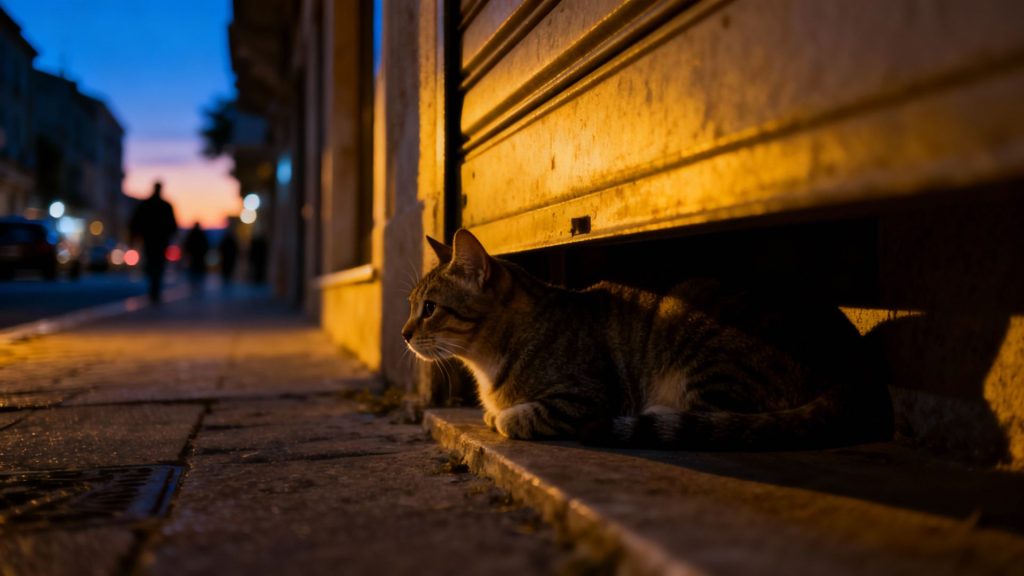
In the fading light of dusk, a silhouette emerges from beneath the garden hedge – a domestic cat, its body coiled with poised tension. Eyes like twin emeralds pierce the gloom, ears twitching at the faint rustle of a leaf. This silent sentinel, draped in fur that glimmers with moonlit silver, embodies a paradox: a creature of wild instincts woven seamlessly into the tapestry of human habitation. Here, in the quietude of suburbia, it reigns as a ghostly monarch, its presence a reminder of the untamed heart that beats beneath the veneer of domestication.
Evolution sculpted the cat into a nocturnal predator of unparalleled precision. Over 10,000 years, natural selection refined its senses: pupils that expand like dark apertures to capture the faintest photons, whiskers sensitive as seismographs mapping unseen currents, and ears rotating independently to pinpoint the skitter of prey. These adaptations, born in the arid dunes of Africa, now serve in urban jungles, where they detect mice in attics or birds in bushes. The cat’s retractable claws, kept sharp as nature’s blades, allow for silent stalking, while a flexible spine enables contortions that defy gravity, turning garden walls into hunting grounds. This evolutionary legacy is a testament to survival, where every sensory enhancement was forged in the crucible of predation.
Daily life for the domestic cat unfolds as a ballet of survival, a ritual where play mimics the hunt. At dawn, it may engage in mock pursuits, batting at toy mice with precise, calculated swipes – a rehearsal for the real chase. This behavior, rooted in ancestral necessity, conserves energy: cats are crepuscular opportunists, conserving resources through long naps only to unleash bursts of speed when prey appears. In kitchens and alleys, they stalk insects with deadly focus, their silent tread a whisper against linoleum or grass. Hunting is both sustenance and sport, refined through solitary patience; a single pounce can dispatch prey with lethal efficiency, yet failed attempts are studied and learned from, demonstrating an intelligence that adapts to each failure.
Reproduction and social bonds weave a complex tapestry in the cat’s world. Females enter estrus seasonally, signaling readiness with pheromone-laced calls that draw potential mates through moonlit nights. After a brief, often solitary gestation, kittens are born blind and helpless, nestled in hidden dens like forgotten closets. Maternal care is fierce and instinctive: the mother grooms each kitten with meticulous care, teaching them to hunt through play – a nudge here, a shared catch there. As they mature, cats display territoriality, rubbing scent glands on furniture to mark boundaries, while vocalizations like purrs or growls facilitate communication. Though often seen as solitary, feral colonies form loose hierarchies, where mutual grooming and shared vigilance foster kinship, revealing a spectrum of social connection honed by isolation and necessity.
Within human-dominated landscapes, the cat plays a dual ecological role. As a natural predator, it suppresses rodent populations in barns and homes, acting as an unsung ally against pests that threaten crops and health. Yet, this benefit is shadowed by controversy: free-roaming cats hunt birds and small mammals, contributing to declines in native species where introduced widely. Studies, such as those reported by wildlife biologists, estimate cats impact billions of birds annually. Despite this, their integration into ecosystems highlights adaptability, transforming them into keystone figures in modified environments – a bridge between nature and civilization that demands responsible stewardship.
The cat’s tale now faces modern challenges, with threats like overpopulation casting a pall. Stray cats, proliferating due to abandonment and lack of neutering, endure hardships from disease to traffic, while conservation efforts, such as trap-neuter-return programs spearheaded by organizations, offer hope. Data shows these initiatives stabilize colonies, yet ethical debates persist. In this twilight, the cat emerges as a symbol of resilience, its survival through millennia reminding us of nature’s enduring balance – a call to protect the wild within the tame.
Ultimately, the domestic cat’s journey speaks to the eternal dance of adaptation and cohabitation. Its silent prowl through our lives mirrors the broader narrative of life’s tenacity, inviting reflection on humanity’s role in shaping the natural world. Here is a creature that embodies paradox: fragility intertwined with ferocity, solitude juxtaposed with connection. In its presence, we find a microcosm of evolution’s artistry, urging us to honor the wilderness that whispers in every shadowed corner, a legacy that endures beyond the confines of hearth and home.