Whispers in the Twilight: The Enigmatic Journey of the Domestic Cat, Guardian of Thresholds
Once solitary hunters of the ancient wilds, now cherished companions, cats embody an evolutionary paradox: fierce independence intertwined with subtle social bonds.
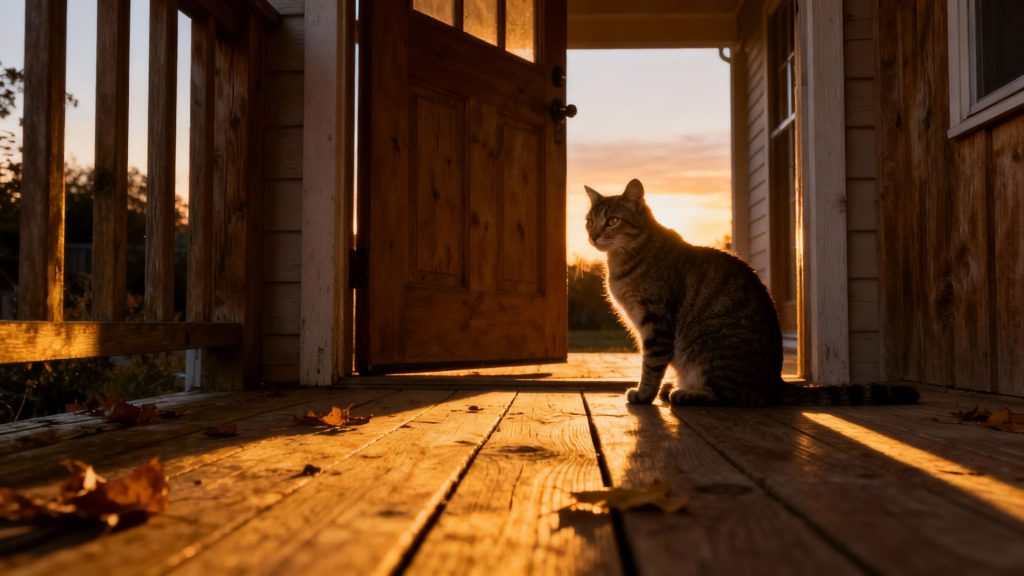
In the violet hour when day surrenders to night, a shadow detaches itself from the garden foliage—a domestic cat, its emerald eyes capturing the last ambient light. This silent observer moves with liquid grace, each paw placed with deliberate precision, embodying the wilderness within our cultivated spaces. Its presence transforms the familiar backyard into a realm where ancient instincts pulse beneath velvet fur, a living bridge between untamed nature and human hearth.
Evolution forged the cat into a masterpiece of sensory adaptation. Vertical-slit pupils expand like lunar crescents to gather photons in near darkness, while specialized tapetum lucidum reflects light through retinas twice. Whiskers, precisely calibrated to the width of its body, map air currents and narrow passages with neurological precision. These evolutionary heirlooms, refined over 10 million years, transform ordinary nights into hunting galleries where the faintest rustle becomes a sonar blueprint for survival.
Even in domesticity, cats perform their ancestral ballet of predation. The stalk-pounce-kill sequence remains encoded in muscle memory, practiced on toys with lethal seriousness. Territorial boundaries are maintained through pheromone signatures deposited by facial glands during bunting rituals. This spatial governance extends to vertical domains—bookshelves become mountain ridges, curtain folds transform into jungle canopies in a daily reenactment of environmental mastery that belies their sleeping hours.
Reproductive strategies reveal fascinating contradictions. Though ancestrally solitary, resource-rich environments foster ephemeral colonies where queens synchronize estrus cycles. After sixty-three days of gestation, blind kittens emerge, their survival dependent on maternal devotion. The queen teaches hunting through progressive prey presentation—first dead, then injured, finally live—a pedagogical sequence honed since the Fertile Crescent, where wildcats first entered granaries.
Ecologically, cats occupy dual roles as both benefactors and disruptors. In agrarian settings, their rodent control prevents crop loss and disease transmission, saving countless human lives historically. Yet free-roaming felines now threaten 430 endangered species worldwide. This paradox positions them as unwitting indicators of ecosystem fragility, their hunting success revealing imbalances in habitats where native predators have vanished.
Urbanization presents modern trials: concrete jungles replace savannahs, traffic flows become lethal rivers, and toxicants accumulate in prey. Responsible stewardship through TNR programs and enriched indoor environments offers compromise. The cat’s resilience mirrors nature’s regenerative power—a testament to adaptation that invites humanity toward coexistence. In their vertical leaps and contemplative gazes, we recognize a shared capacity for wonder, a silent dialogue between species that began when grain stores first attracted wild hunters to human settlements.