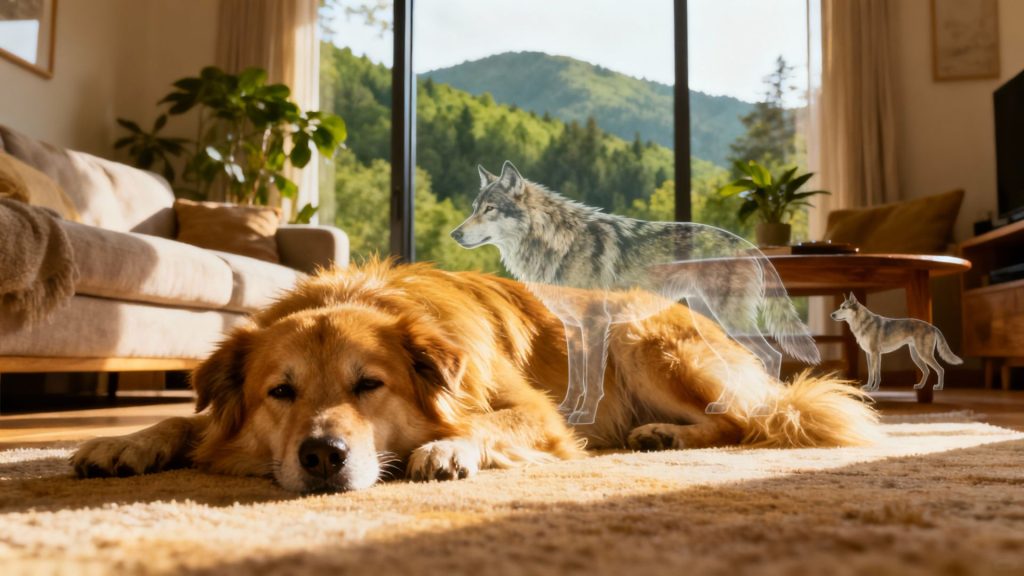
Silent Echoes in Domestic Souls: The Dog, a Timeless Voyage from Wilderness to Humanity’s Hearth
Forged in Ancient Symbiosis, This Guardian of Hearts Navigates the Loss of Wildness and Urban Perils, Emerging as Earth’s Most Enduring Symbol of Inter-Species Trust and Resilience.
Dawn breaks over a mist-shrouded meadow, where a silhouette materializes—part shadow, part sentience, its presence a whisper of millennia past. It is a dog, yet in that initial encounter, it evokes its lupine ancestors: the alert tilt of its ears, the keen scan of amber eyes piercing the fog, each movement an echo of untamed wilderness tamed by an unspoken pact with humanity. This guardian stands at the threshold of two worlds, embodying a paradoxical blend of fierce independence and unwavering loyalty, setting the stage for an epic tale of survival and connection that spans epochs.
Over thirty thousand years ago, along the fringes of human encampments, a dance of mutual benefit began. Wolves, drawn by discarded scraps, found in early humans not just food but protection. Natural selection sculpted this bond: mutations in genes like WBSCR17 favored traits such as reduced aggression and heightened sociability, transforming apex predators into companions. This evolutionary blade honed abilities like superior olfaction, capable of detecting parts per trillion, and cognitive empathy, allowing dogs to read human emotions—adaptations forged in the crucible of survival, now the bedrock of their role as humanity’s first domesticated allies.
Each day unfolds as a living poem of instinct and adaptation, where play becomes a rehearsal for ancient hunts—chasing balls mirroring the pursuit of prey, while burrowing into blankets echoes den-building behaviors honed in wild dens. Loyalty, rooted in pack hierarchies, manifests in vigilant patrols of home territories; their barks, evolved as alarm calls, serve as modern guardians against intruders. Sensory gifts, like hearing frequencies beyond human range and detecting minute scat trails, enable them to navigate urban jungles with ancestral grace, turning mundane routines into symphonies of survival.
In the intricate web of lineage, reproduction reveals nature’s artistry. Seasonal estrus cycles, inherited from wolves, ensure synchronized breeding, while maternal instincts drive mothers to nurture litters in hidden dens—whisking pups to safety at the faintest threat. Social structures, often forming packs with humans as alpha figures, foster cooperative care: siblings share warmth, adults mentor young in skills like scent-tracking, weaving bonds that sustain genetic legacy through generations of faithful companionship.
As ecological linchpins, dogs shape micro-environments subtly yet profoundly. Historically, they aided in pest control by hunting rodents, while their presence in human settlements influenced disease dynamics by reducing stress levels, as documented in studies linking pet ownership to lower cortisol. Today, they act as ecosystem sentinels, their domestication altering landscapes—once wild hunters now serve as therapy animals, their empathy bridging gaps in mental health, and their scavenging habits mitigating waste in human habitats, underscoring their role as keystone species in the anthropocene era.
Despite thriving globally, threats loom: genetic bottlenecks from selective breeding trigger ailments like hip dysplasia, while abandonment and habitat encroachment leave strays vulnerable to disease and predation. Conservation, however, offers dawns: initiatives like the International Partnership for Dogs promote genetic diversity and responsible ownership, curbing overpopulation through spay programs, and research into wolf-dog hybrids informs strategies to preserve ancestral traits, ensuring this symbiont’s journey endures with resilient hope.
In the dog’s gaze, we glimpse a mirror to our own humanity—trust woven from vulnerability, resilience etched in every wagging tail. They are living relics of a shared evolutionary path, teaching that coexistence is not conquest but communion, their silent echoes a reminder that in the heart of domestication, the wild soul still sings, urging us toward a deeper reverence for all life’s interconnected tapestry.