Whispers of Loyalty: The Epic Journey of Dogs from Wild Wolves to Domestic Devotion
Transforming from apex predators to beloved family members, dogs have reshaped ecosystems, influenced human evolution, and forged an unbreakable bond of trust and companionship.
Imagine standing on the edge of a misty forest at dawn, the first light of day filtering through ancient trees to reveal a silhouette padding silently through dew-kissed undergrowth—this is not a wolf, though its ancestry echoes in every sinew and stride; it is a dog, humanity’s first and most enduring companion. In this quiet moment, the wild-domestic divide dissolves, transporting us to a primordial alliance born not of conquest but of mutual curiosity. As the air carries the faint scent of earth and fur, we witness a living testament to an ancient covenant, where early humans shared campfires with wolves that dared to approach, initiating a bond that would echo through millennia. The sheer presence of this creature evokes a sense of awe, inviting us to ponder how such deep connection could emerge from the raw wilderness.
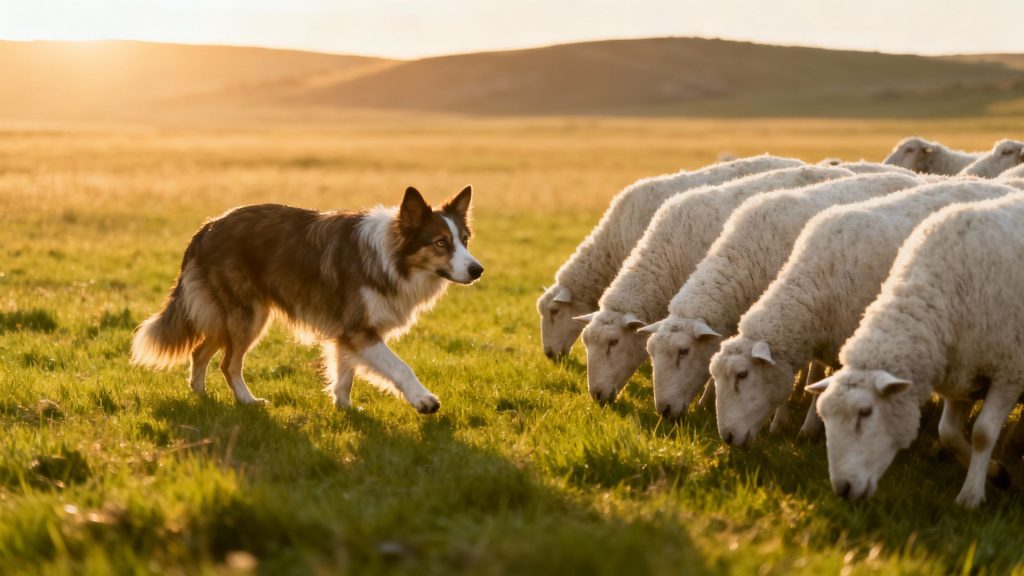
The domestication of dogs stands as one of evolution’s most profound masterpieces, sculpted by natural selection over 15,000 years. Scientific studies, such as those by geneticist Robert Wayne, illuminate how selective pressures favored wolves with traits like reduced aggression and heightened social cognition, allowing them to thrive alongside humans. Key genetic adaptations, including mutations in the WBSCR17 gene linked to oxytocin pathways, amplified dogs’ ability to interpret human gestures and emotions—turning them from solitary hunters into cooperative partners. This evolutionary journey was not a gentle drift but a deliberate forging, where wolves that scavenged human scraps or served as sentinels against predators passed on their genes. Today, this legacy manifests in breeds as diverse as the alert Border Collie and the gentle Labrador, each a living archive of survival strategies refined through ages.
In their daily existence, dogs weave a survival poem of remarkable ingenuity, transforming household routines into opportunities honed by millennia. Their foraging instincts, inherited from wolf ancestors, turn mundane activities like mealtime into efficient scavenging, while play behaviors—such as chasing balls or wrestling—serve as vital practice for hunting and social bonding. Communication becomes an art form: barks convey warnings, whines express need, and body language like tail wags or ear positions navigates complex human interactions with uncanny precision. This adaptability extends to their diets, which have shifted from raw prey to processed foods, yet retained the efficiency of carnivorous digestion. Through these acts, dogs demonstrate a resilience that is both functional and poetic, turning everyday survival into a ballet of instinct and intelligence.
The lineage of dogs unfolds in a tapestry of kinship, where reproduction and nurturing transcend mere biology to embody deep emotional bonds. Breeding cycles, now less rigid due to human influence, still pulse with primal instincts—mother dogs display unwavering devotion, nursing and guarding puppies in secluded dens for weeks. Social structures vary; breeds like the Siberian Husky mimic pack hierarchies with alpha roles, while others integrate as equal members in human families. This kinship extends beyond genetics, fostering loyalty that often mirrors human relationships, such as dogs grieving lost companions or forming lifelong attachments. The result is a testament to life’s enduring need for connection, where each litter renews the promise of continuity and devotion.
Within human-dominated landscapes, dogs emerge as ecological cornerstones, subtly shaping environments through roles like companionship, guardianship, and conservation aids. Their presence reduces human stress and promotes physical health, as seen in therapy dog programs that aid mental well-being. Yet, their influence also bears complexity: feral populations can disrupt local ecologies by preying on small mammals, while their role as early warning systems for threats like fires or intruders underscores their interdependence with humans. As defacto ecosystem engineers, they bridge natural and urban worlds, reminding us that domesticity does not divorce them from ecological roles but redefines them as keystones of human society.
Today, dogs face a twilight of challenges, from abandonment and overpopulation in shelters to diseases like rabies and genetic disorders from inbreeding. Conservation efforts, such as global vaccination campaigns and legislation like the U.S. Animal Welfare Act, offer beacons of hope, curbing threats and promoting responsible ownership. Yet, the dawn of solutions lies in education—teaching communities about spaying/neutering and adoption—that can stabilize populations. This delicate balance acknowledges vulnerability without despair, fostering a future where dogs thrive not as casualties but as cherished partners in our shared journey.
In the silent dialogue between species, dogs embody lessons of resilience, empathy, and unconditional love—eternal ambassadors bridging the wild and the tame. They illuminate how evolution celebrates connection over isolation, urging us to reflect on our own humanity: the courage to adapt, the capacity for trust, and the responsibility to protect. As we gaze into their eyes, we glimpse a timeless truth—that in nurturing this bond, we honor the fragile, intricate web of life itself.