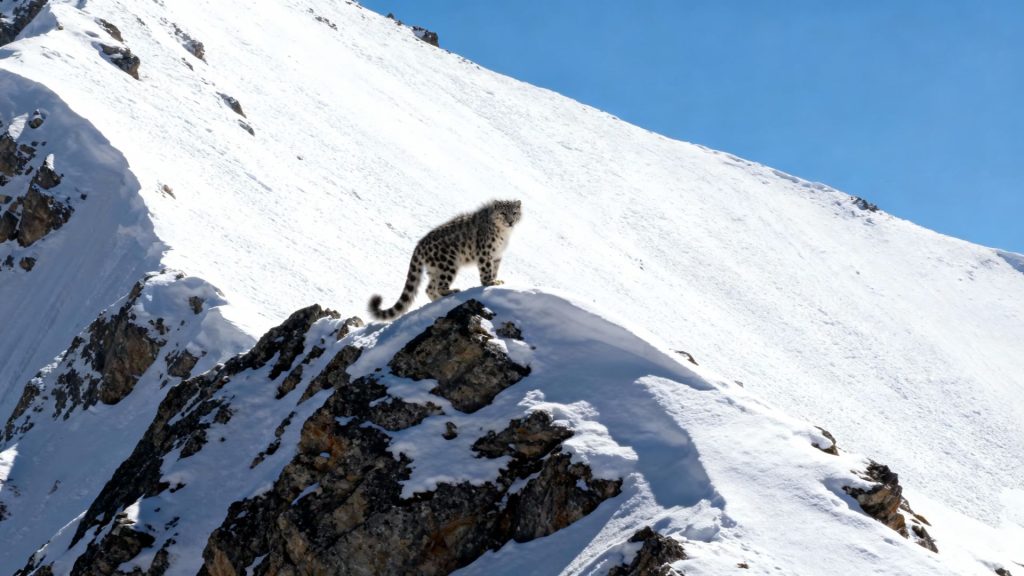
Whispers of the Frozen Peaks: Snow Leopard, Guardian of Solitude in Earth’s Highest Sanctuaries
Elusive master of the thin air, Panthera uncia has sculpted survival over millennia in the world’s harshest mountains, now facing the silent erosion of its realm by human pressures and climate upheaval.
Imagine the first light of dawn creeping over the jagged spine of the Himalayas, where shadows cling to crevasses and frost etches patterns on ancient stone. Here, in this cathedral of rock and ice, a ghostly form materializes—a snow leopard, its coat a tapestry of grey and white that melts into the granite. It moves with liquid grace, a solitary sentinel surveying a kingdom where oxygen is scarce and silence reigns supreme. This initial encounter, a fleeting glimpse in the wild, evokes a profound sense of awe, as if the mountains themselves have breathed life into a myth. The air is thin, biting cold, yet charged with the raw energy of an ecosystem untouched by time, where every step echoes the resilience of life at the edge of existence.
The snow leopard’s evolution is a testament to nature’s relentless forge, honing adaptations that defy the brutal alpine environment. Its thick, insulating fur, dense as a winter storm’s blanket, shields against temperatures plunging to -40°C, while oversized paws act as natural snowshoes, distributing weight to navigate treacherous slopes without sinking. Most remarkably, its elongated tail—nearly a meter long—serves as a counterbalance during dizzying leaps across chasms, a feat of biomechanical engineering refined over millennia through natural selection. These traits are not mere quirks but survival tools, sculpted by the harsh realities of high altitudes where only the fittest endure, transforming this cat into a living embodiment of evolutionary ingenuity in the planet’s most inhospitable realms.
Daily survival for the snow leopard is a silent ballet of stealth and precision, played out on a stage of sheer cliffs and snowfields. As an apex predator, it relies on ambush tactics, stalking prey like blue sheep or ibex with movements so fluid they seem to dissolve into the landscape. A single hunt can span hours, culminating in a burst of explosive power—a leap from cover, claws extended, to deliver a fatal bite to the neck. This strategy conserves energy in an environment where calories are scarce, with each successful kill sustaining the cat for days. Beyond hunting, the snow leopard’s nomadic existence involves traversing vast territories, up to 100 square kilometers, in search of food and mates, its solitary nature a stark contrast to the social herds it preys upon, revealing a life defined by calculated patience and the unyielding rhythm of survival.
In the realm of reproduction, the snow leopard’s life pulses with a delicate balance of isolation and connection. Mating occurs in winter, triggered by scent markings and vocal calls that pierce the mountain silence, leading to brief encounters between solitary individuals. After a gestation of about 100 days, females retreat to hidden dens—rock crevices or caves—to give birth to one to three cubs, each blind and vulnerable. For the next 18 months, the mother dedicates herself to nurturing, teaching cubs to hunt and navigate the perilous terrain through patient demonstrations. This intimate bond, though fleeting, underscores a profound investment in the next generation, where the survival of each cub hinges on lessons passed down in the shadow of glaciers, a testament to life’s enduring cycle in the face of overwhelming solitude.
As a keystone species, the snow leopard anchors the fragile tapestry of high-altitude ecosystems, its presence rippling through the food web. By regulating populations of herbivores like Himalayan tahr, it prevents overgrazing that could devastate alpine meadows, preserving biodiversity and soil stability. Its role extends beyond predation; as an indicator species, the health of snow leopard populations signals broader environmental shifts, such as climate impacts on snowpack and vegetation. In this way, the cat is a barometer for the mountains’ vitality, its existence woven into the survival of countless other species, from marmots to birds of prey, highlighting how one predator’s fate echoes through the intricate web of life in Earth’s rooftop realms.
Today, the snow leopard’s twilight is fraught with challenges, yet dawns with hope through concerted conservation. Primary threats include poaching for its luxurious fur and bones, driven by illegal wildlife trade, and habitat fragmentation from infrastructure like roads and mining. Climate change compounds these issues, altering snow patterns and reducing prey availability. However, initiatives led by organizations such as the Snow Leopard Trust, involving community-based monitoring and anti-poaching patrols, have stabilized some populations. Scientific data shows an estimated 4,000-6,500 individuals remain across 12 countries, with protected areas expanding. This reality is not one of despair but a call to action, emphasizing that human stewardship can reverse declines, ensuring the ghost of the peaks endures as a symbol of wild resilience.
In the grand dialogue of existence, the snow leopard speaks to the essence of life’s tenacity—a solitary figure thriving in extremes, embodying the paradox of strength and vulnerability. Its journey invites reflection on humanity’s place in nature, urging us to embrace humility and stewardship. For in this cat’s silent watch over the mountains, we find a mirror to our own fragility and a reminder that true wilderness is not just a place but a state of being, where every heartbeat resonates with the ancient pulse of the planet, inspiring a deeper reverence for the interconnectedness of all life.