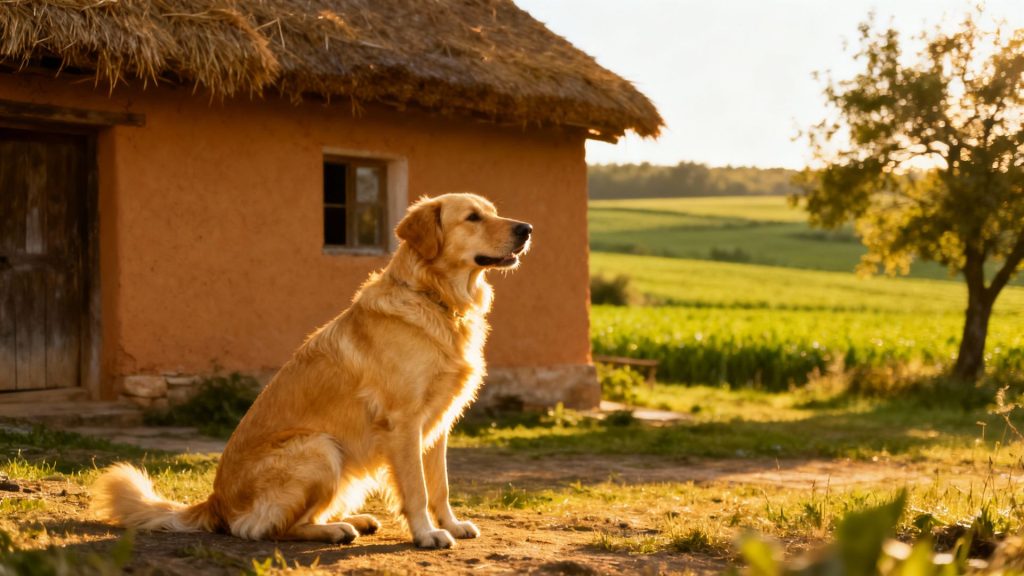
Guardians of the Hearth, Companions of the Soul: The Domestic Dog’s Journey Through Millennia of Loyalty
From ancestral wolves to devoted partners, dogs have reshaped human history with unparalleled adaptability, forging bonds that echo through time, yet now navigate modern perils in a rapidly evolving world.
Imagine the first light of dawn breaking over a primordial landscape, where a shadow moves with silent grace—a wolf, ancestor to all dogs, its amber eyes scanning the horizon. This moment, millennia ago, marked the genesis of a partnership that would transcend species. In that wilderness encounter, early humans witnessed not a predator, but a potential ally, whose keen senses and social instincts hinted at a future woven into the very fabric of civilization. Today, as you walk through a meadow, a dog might bound toward you, tail wagging, embodying that ancient promise: a guardian of the hearth, a companion in solitude, forever bridging the wild and the domestic.
Natural selection sculpted dogs into masters of adaptation, honing traits like their extraordinary olfactory prowess—40 times more sensitive than humans—allowing them to detect scents imperceptible to us. This evolutionary gift, refined over 15,000 years from gray wolves, enabled survival in diverse niches, from Arctic tundras to arid deserts. Their ability to read human emotions through subtle facial cues and vocal tones, a trait studied in research by institutions like the Max Planck Institute, showcases how domestication forged a unique cognitive edge, turning them into intuitive partners rather than mere followers.
Daily survival for dogs unfolds as a symphony of instinct and learned behavior. In the wild, they might hunt in packs, coordinating with silent signals to bring down prey, but as companions, this translates to vigilant patrolling of homes or playful retrieval of toys. Their diet, once raw meat scavenged from kills, now adapts to human-provided nutrition, yet their innate foraging drive persists in activities like digging or sniffing trails. This versatility, documented in ethological studies, reveals a creature that thrives on routine yet remains ever-alert to environmental shifts, embodying resilience in every wag of the tail.
Reproduction in dogs is a testament to life’s continuity, with females entering estrus twice yearly, signaling readiness through pheromones and behavior. Males, driven by primal urges, compete for mates, yet post-birth, a profound shift occurs: mothers nurture pups with meticulous care, licking them clean and teaching essential skills. Social structures vary—from solitary strays to complex packs in feral groups—but always emphasize hierarchy and cooperation. This familial bond, observed in wild canids like African wild dogs, underscores the evolutionary wisdom in communal rearing, ensuring offspring inherit survival tactics through generations.
As ecological linchpins, dogs serve as keystone species in human-dominated ecosystems. They control pest populations by hunting rodents, aid in seed dispersal through their movements, and act as sentinels for environmental health, their sensitivity to pollutants alerting us to ecological imbalances. In urban settings, their presence reduces stress and fosters community bonds, as shown in studies linking pet ownership to lower cortisol levels. Yet, this role is double-edged; their dependence on humans makes them vulnerable indicators of societal neglect, reflecting our stewardship—or lack thereof—over shared habitats.
Modern threats loom large, with overpopulation from uncontrolled breeding leading to millions of strays worldwide, vulnerable to disease, accidents, and habitat loss. Conservation efforts, such as spay-neuter programs championed by organizations like the World Health Organization, offer hope, reducing euthanasia rates and promoting responsible ownership. Climate change exacerbates risks, altering disease vectors like ticks that spread Lyme disease. Still, resilience shines through in rescue initiatives and genetic research, preserving breeds and wild relatives, reminding us that extinction is not inevitable but a call to action.
In the dog’s unwavering gaze, we glimpse the eternal dialogue between species—a testament to coevolution’s power, where loyalty and adaptability forge unbreakable ties. Their journey mirrors our own quest for connection, teaching humility in the face of nature’s complexity. As stewards of this bond, we inherit a responsibility: to honor their legacy by safeguarding the wild within, ensuring that the hearth’s guardian endures not as a relic, but as a beacon of interspecies harmony in an uncertain world.